My AI Survey Tool Makes $1,500/Month With No Subscriptions
Who are you and what business did you start?
Hi, I'm Wei Tao, the founder of Wavefield Research, based in Toronto.
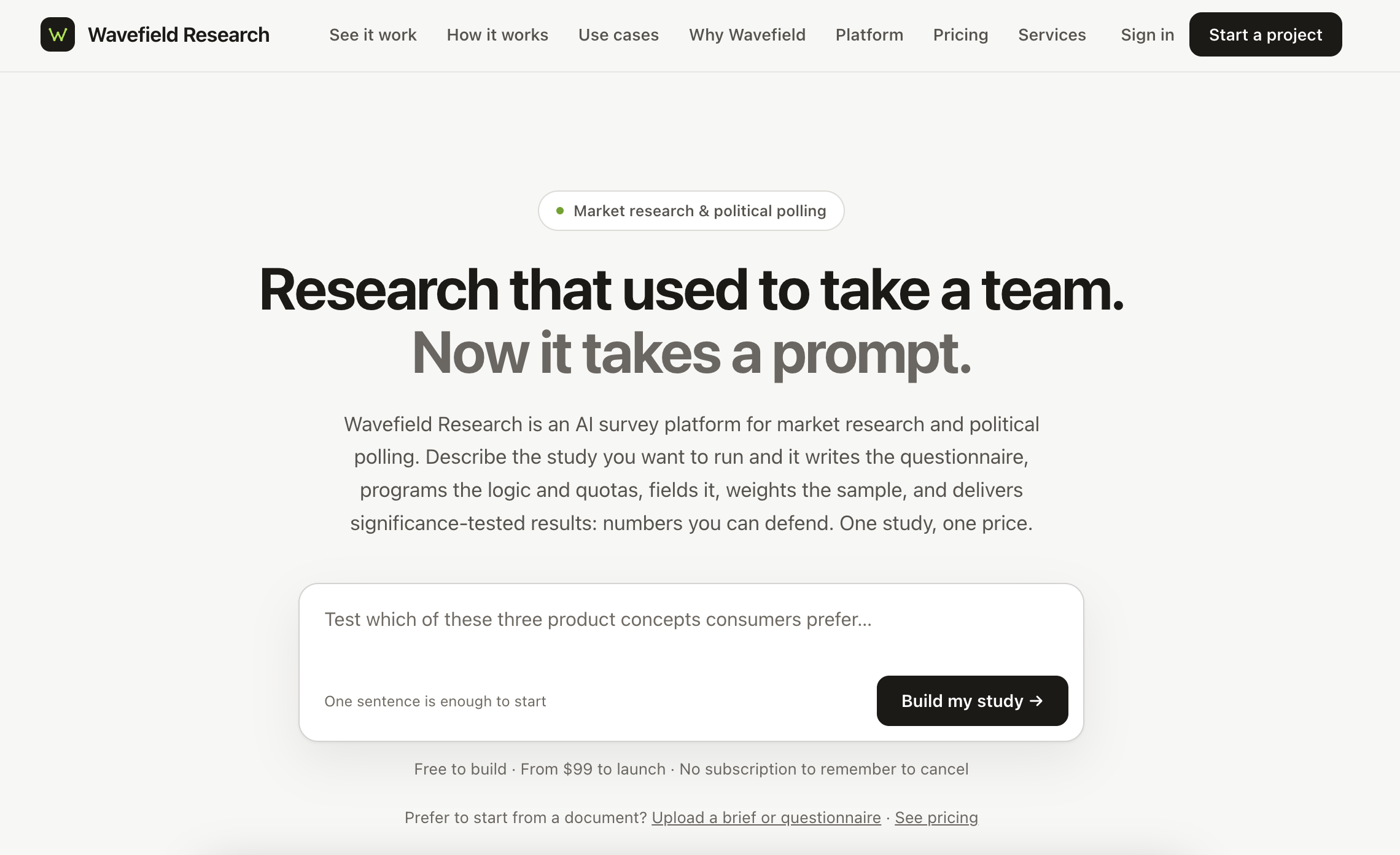
Wavefield is a survey platform for people who need one properly run study and do not want a year-long software contract to get it. You describe the study in plain language or upload a brief, and an AI agent builds the questionnaire, including the skip logic, quotas and screening questions. You send it to your own contacts or to panel respondents. The results come back weighted and tested for statistical significance, with crosstabs and SPSS exports.
My customers are small research teams, consultants and political campaigns. Two things set it apart. Building a survey is free and a project costs $99 to $299, with no subscription. And every report shows its real sample sizes and margins of error, including when they are unflattering.
We launched in August 2026. We are early: about $5,000 in revenue in the first three months, nearly all of it from one client's two-wave study.
How do you come up with the idea for Wavefield Research?
I was working at a research company, and I watched the same three problems repeat on almost every project.
The first was time. Building a research survey took our clients days. Someone wrote the questionnaire in a document, and then someone else programmed it by hand, question by question, with all the skip logic.
The second was fieldwork. Once the survey was live, it took more days of follow-up to keep the quotas on track and to check the data quality. People were watching counts in spreadsheets and removing bad responses one at a time.
The third was the numbers. When the results came back, clients sometimes got lost in the statistics. They could not tell which differences were real and which were noise, so they either trusted everything or trusted nothing.
So I decided to build the tool that I wished those clients had. In Wavefield, an AI agent builds the survey from a brief in minutes. Quotas and quality checks run automatically while the survey is in the field. The report marks which differences are statistically significant in plain terms.
I did not trust it until I had checked it. Before launch I took a full-length political poll, had the agent build it, collected test responses, and compared the weighted numbers in the report against a hand calculation from the raw data file. They matched.
How did you launch Wavefield Research and get initial traction?
I launched in August 2026 the way the playbook says: Product Hunt, listings on G2 and Capterra, and a Google Ads campaign. None of it produced a paying customer. I ran the ads for about ten weeks, could not trace a single signup to them, and switched them off on the date I had set in advance for that decision.
The first real customer signed up on September 24. He was a political consultant in the United States who needed a voter study in a hurry. He built the survey himself, asked a few pointed questions by email, and four days later wrote back one word: "go." The survey was in the field the next day. My first invoice went out on October 6 for $2,376 and was paid within the week.
Later I asked how he had found us. I expected him to say Google. His answer was: "I found you through using Claude. It recommended to check you out." An AI assistant had sent me my first customer, and nothing in my marketing plan had accounted for that.
What was the growth strategy for Wavefield Research and how did you scale?
It is early, so here is what has worked so far and what has not.
What did not work: paid search. Ten weeks, no customers, turned off.
What worked first: being easy for AI assistants to recommend. I cannot buy that placement, and I only have one data point, so I treat it as a habit and not a formula. The site has a page for nearly every question a survey buyer asks, and each page says plainly what the product does not do. There is also a plain-text index of the site written for AI systems. When an assistant looks for a research-grade survey tool with no subscription, there is something specific and honest for it to quote.
Search is the long game. I have published 81 pages in about four months. Each one starts with a teardown of what already ranks, and each one gets a written prediction with a date on which I will call it a failure. The pages that earn attention fastest are the free tools: calculators for sample size, Net Promoter Score, CSAT and statistical significance. A working tool gets used and linked where an article gets skimmed.
Links I earn by asking, never by paying. Most "best survey tools" lists turn out to be paid placements. One publisher answered my pitch by offering to send their rates. I pass on those and pitch research directories and university resource pages, where a real person decides what is useful.
What were the biggest lessons learned from building Wavefield Research?
Ask every customer how they found you. I had a theory, a tracking setup and an ad budget built around it, and one sentence from my first customer showed all three were wrong.
Set the kill date before you start. I decided up front when I would judge the ad campaign and what would count as failure. When the date came, the decision took five minutes and I felt no urge to give it one more month. I now do this for everything: each page, each outreach batch, each experiment gets a written prediction and a deadline.
Check your own product the hard way. My buyers are people whose numbers get challenged in public. Before launch I verified the statistics by hand, and it is the reason I can answer a methodology question without flinching.
Discover Similar Business Ideas Like Wavefield Research
|
|
Idea
|
Revenue
|
|---|---|---|

Ai-powered resume builder
rezi.ai
AI-powered resume builder for job seekers.
|
AI-powered resume builder for job seekers. |
$215K /mo |

Reddit audience research tool
gummysearch.com
Audience research tool for Reddit users
|
Audience research tool for Reddit users |
$1K /mo |

AI voice notes organizer
talknotes.io
AI voice note app turning thoughts into organized tasks.
|
AI voice note app turning thoughts into organized tasks. |
$6.5K /mo |

No-code Airtable API importer
datafetcher.com
API integration tool for Airtable users.
|
API integration tool for Airtable users. |
$23K /mo |

Trend discovery platform
treendly.com
Trend-spotting platform for untapped market insights.
|
Trend-spotting platform for untapped market insights. |
$1K /mo |

AI daily planning app
structured.app
Visual daily planner for focused productivity
|
Visual daily planner for focused productivity |
$1K /mo |

Podcast guest booking platform
guestio.com
Marketplace connecting podcast hosts with paid guest bookings
|
Marketplace connecting podcast hosts with paid guest bookings |
$150K /mo |
More about Wavefield Research:
Who is the owner of Wavefield Research?
Wei Tao is the founder of Wavefield Research.
When did Wei Tao start Wavefield Research?
2026
How much money has Wei Tao made from Wavefield Research?
Wei Tao started the business in 2026, and currently makes an average of $18K/year.
More Case Studies Like This





Starter Story × HubSpot
Free tools for every part of your business.
Find customers, win deals, and automate the busywork with HubSpot's free tools.