How We Built A $50K/Month AI Agent Platform For Paid Media Teams
Who are you and what business did you start?
Hi, I'm Aditya Sriram, one of the three co-founders of GoMarble. I look after growth and operations. Palkush Rai Chawla is our CEO and Swapnil Bari is our CTO, and we're based in Bengaluru.
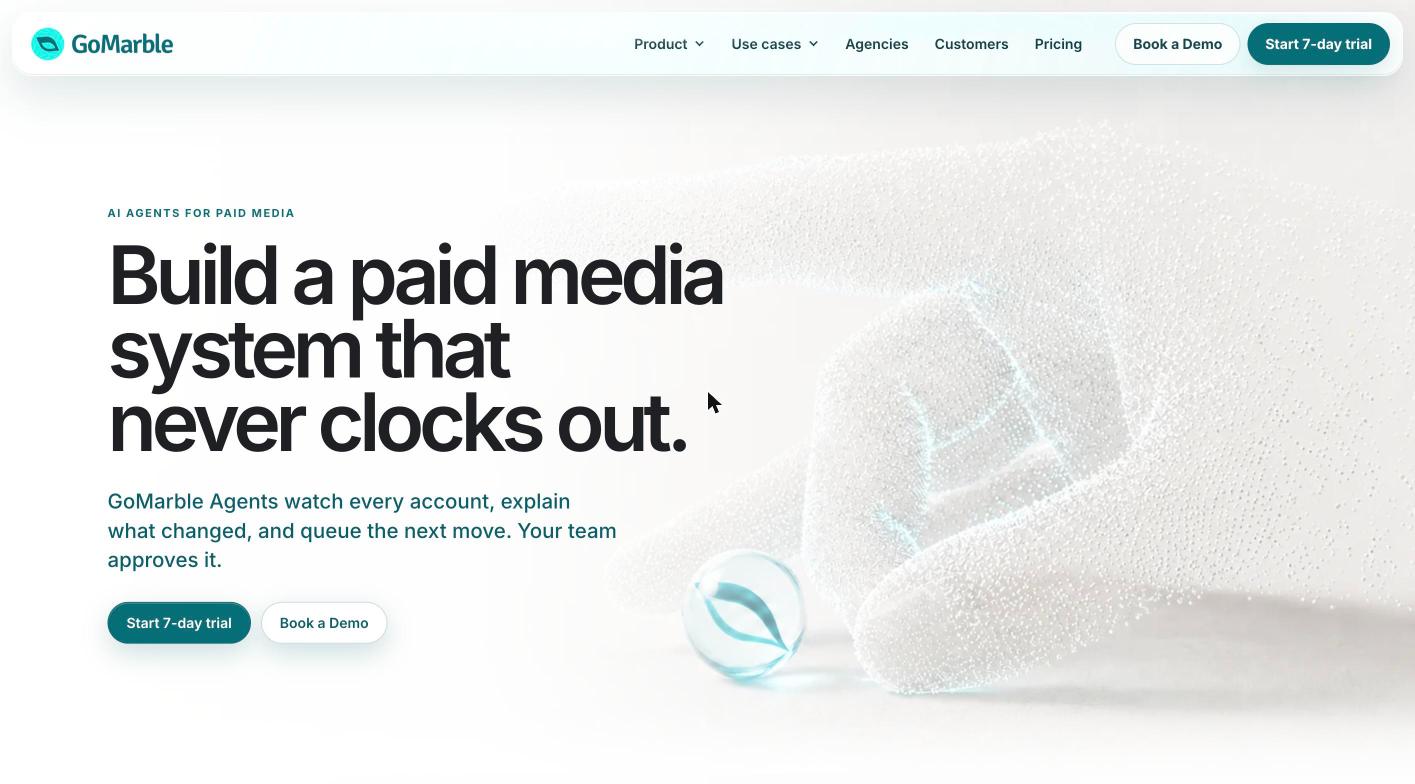
GoMarble builds AI agents for paid media teams at brands and agencies. A team connects Meta, Google, TikTok, LinkedIn and Microsoft Ads along with GA4 and Shopify. The agents watch every campaign, work out what changed and why, analyse which creative is working, and bring proposed fixes to the team: budget shifts, bid and status edits, negative keywords and new ad launches. They stay inside the permissions the team sets, every action is recorded, and they keep each brand's context current, so the advice gets more specific over time.
Today GoMarble is connected to more than 12,000 ad accounts with over $250M in monthly ad spend.
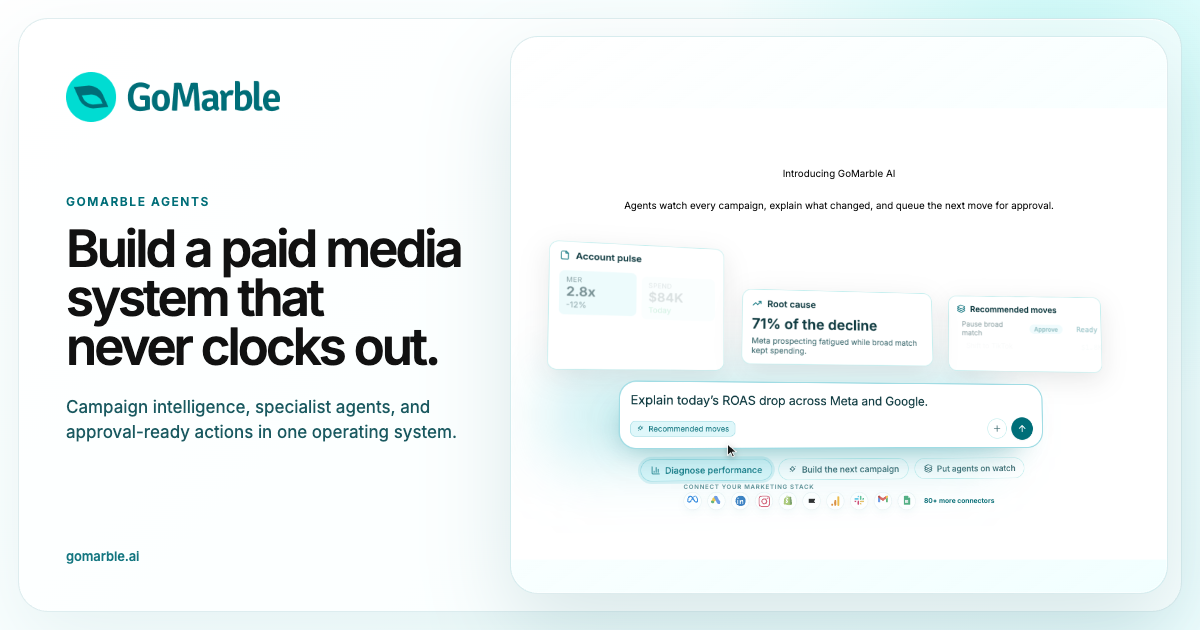
GoMarble: AI agents for paid media teams
How do you come up with the idea for GoMarble?
Palkush and I became roommates in our first year at IIT Kharagpur in 2007. Years later, Palkush and Swapnil worked together at ShareChat. Palkush has built two companies and worked on monetisation at ShareChat and ITC, Swapnil was a staff engineer at ShareChat and Goldman Sachs, and I led growth at Rupeek after working at BCG and McKinsey.
GoMarble started with too many tabs. From May 2024 to May 2025 we ran Google and Meta ads for 20 US brands, about $200K a month in spend. Clients hired us to think about growth, but most mornings went on piecing together what had happened in the account: Ads Manager, an export, a spreadsheet, the launches, the right creative, the report. By lunch we finally knew what had happened yesterday.
We tried ChatGPT, but it only knew what we pasted in, and every new chat started from scratch. That was the aha moment: the hard part wasn't the AI, it was the context. So we built a tool for our own accounts that connected the data, held each brand's history and investigated the questions we asked every week. That tool became GoMarble, and the year of running real accounts was our validation.
How did you build the initial version of GoMarble?
GoMarble started as an internal tool that the founders built for their own ad accounts. From May 2024 to May 2025, they ran Google and Meta ads for 20 US brands, about $200K a month in spend, and built a tool that connected the account data, kept each brand's history, and ran the weekly investigations they kept doing by hand. Their first public build was an MCP server for advertising, released in April 2025, which connected Meta Ads (and later Google Ads) directly to Claude so marketers could query their accounts. The core challenge was context: ChatGPT only knew what they pasted in and started from scratch each chat, so they had to build persistent memory for each brand. A later challenge was trust, since agents that change live campaigns put real money at risk, so they built in permission limits and a log of every action.
How did you launch GoMarble and get initial traction?
Our first revenue came from that services work, so brands were paying us before the product existed.
Our first real launch came in April 2025, when we released one of the world's first MCP servers for advertising. It let marketers connect their Meta Ads account straight to Claude and ask questions about it, and we followed it with one for Google Ads. The LinkedIn post announcing it brought in more than 5,000 comments, and those conversations turned into a Slack community of over 1,000 marketers. Their questions shaped the product: can it watch the account while I sleep, catch a problem before my client does, remember how our team works, and make the change safely?
So when we launched the full product in October 2025, we already had an audience: the launch posts on X and LinkedIn passed 500K impressions in the first 12 hours. GoMarble has also been #1 Product of the Day on Product Hunt.
The lesson: build an audience before launch day, ideally by putting something genuinely useful in people's hands early.
What was the growth strategy for GoMarble and how did you scale?
Here's what we've tried, what worked, and what didn't.
Founder-led content on LinkedIn, and launches. We write as founders on LinkedIn, and we've done three major launches, each built around a big new capability, such as creative research and agents that take action in ad accounts. A launch tied to something genuinely new gives people a reason to talk about it.
Creator marketing. We partnered with more than 100 creators in the paid media space who genuinely loved the product and were happy to endorse it on LinkedIn, X, Instagram and TikTok. Their audiences are exactly the people we sell to, and a recommendation from someone who runs ads every day carries more weight than anything we say about ourselves.
Being where marketers already work. Our buyers increasingly do their analysis inside Claude and ChatGPT, so GoMarble works inside them too, and we list it in the directories where people look for those integrations.
Programmatic SEO run by AI agents. We publish over 300 pages: ad cost research (like our BFCM cost run-up tracker), a library of brands' ads, comparisons of AI tools, and step-by-step AI workflows for paid media. A set of scheduled AI agents plans the pages, researches them, builds them and reviews each other's work, and a human approves the rules they follow. The pages are written to answer the questions people now ask AI assistants, not just Google.
What didn't work: webinars. One with 62 registrants, nearly half of them existing users, brought zero new signups.
The most useful thing we did was study retention. Teams that, within 30 days, connected both Google and Meta, had 10+ ad accounts, added a second user and used GoMarble from an AI assistant were more than twice as likely to still be customers at day 120 as teams with none of those habits.
My advice: find the habits that predict retention, point your growth at them, and judge every channel on paying customers, not signups.
What were the biggest lessons learned from building GoMarble?
A few things I'd tell anyone starting out.
Start by doing the work for money. Running ads for 20 brands before we built much product gave us paid validation, real data and a long list of problems worth automating.
Earn trust before you ask for it. Explaining a performance drop is easy; changing a live campaign puts money at risk. Our agents show their work, stay inside the permissions a team sets and record every action, and they get more room only once they've earned it. If AI touches real money, "trust me" is not a safety system.
Protect your signal. In April 2026 we stopped accepting personal email signups. We got fewer signups, but far more of them were real teams we could learn from.
Discover Similar Business Ideas Like GoMarble
|
|
Idea
|
Revenue
|
|---|---|---|

Ai-powered resume builder
rezi.ai
AI-powered resume builder for job seekers.
|
AI-powered resume builder for job seekers. |
$215K /mo |

AI app builder platform
lovable.dev
AI platform for effortless app and website creation.
|
AI platform for effortless app and website creation. |
$16.7M /mo |

No-code Airtable API importer
datafetcher.com
API integration tool for Airtable users.
|
API integration tool for Airtable users. |
$23K /mo |

Trend discovery platform
treendly.com
Trend-spotting platform for untapped market insights.
|
Trend-spotting platform for untapped market insights. |
$1K /mo |

Partner marketing platform
everflow.io
Affiliate marketing platform for managing partners and campaigns.
|
Affiliate marketing platform for managing partners and campaigns. |
$2.5M /mo |

AI daily planning app
structured.app
Visual daily planner for focused productivity
|
Visual daily planner for focused productivity |
$1K /mo |

Podcast guest booking platform
guestio.com
Marketplace connecting podcast hosts with paid guest bookings
|
Marketplace connecting podcast hosts with paid guest bookings |
$150K /mo |
More about GoMarble:
Who is the owner of GoMarble?
Aditya Sriram is the founder of GoMarble.
When did Aditya Sriram start GoMarble?
2024
How much money has Aditya Sriram made from GoMarble?
Aditya Sriram started the business in 2024, and currently makes an average of $1.8M/year.
More Case Studies Like This





Starter Story × HubSpot
Free tools for every part of your business.
Find customers, win deals, and automate the busywork with HubSpot's free tools.