How Taylor Jacobson bootstrapped Focusmate to Over 22K Users

Who is Taylor Jacobson?
Taylor Jacobson, the founder of Focusmate, is originally from Newton, a suburb of Boston, and is an alum of Duke University. Initially recognized for his significant professional strides, Jacobson pivoted from a traditional career path, including a job at Oliver Wyman, to exploring entrepreneurship motivated by his personal struggles with procrastination. His journey into entrepreneurship began after turning down a scholarship to Wharton and later evolved through his work as an executive coach, which inspired the creation of Focusmate—a platform designed to enhance productivity through virtual coworking.
What problem does Focusmate solve?
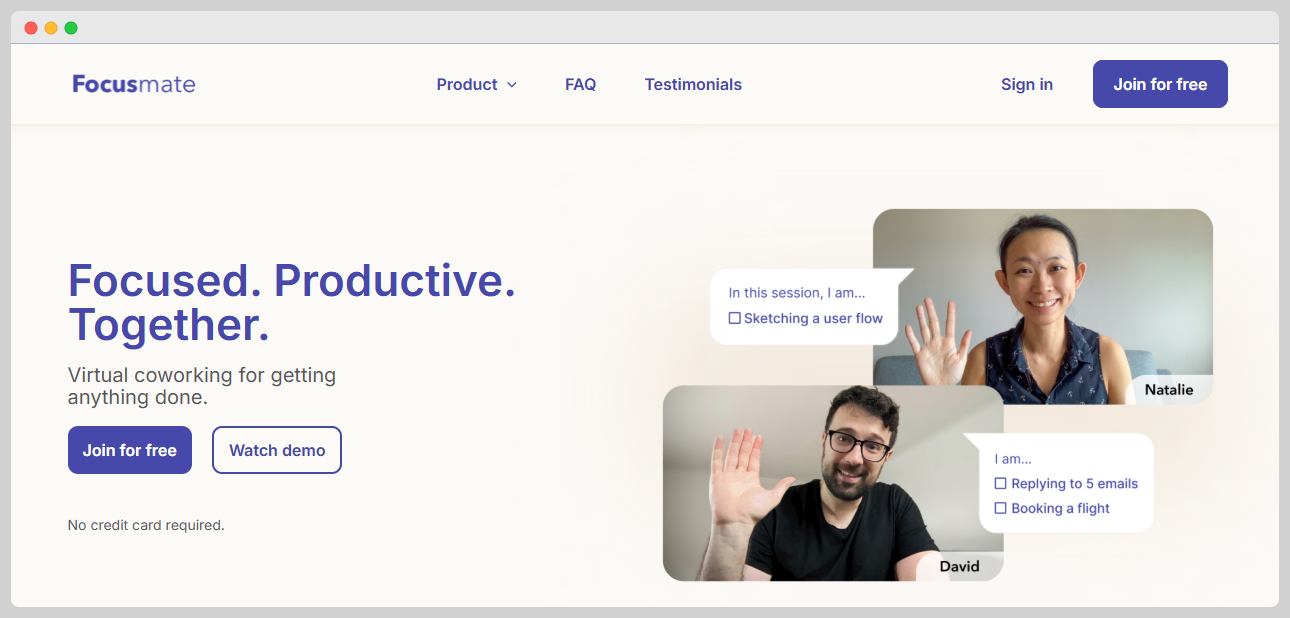
Focusmate helps remote workers who struggle with procrastination by pairing them with a virtual accountability partner, breaking isolation and creating a focused, productive environment.
Founder-Market Fit
Skills
What skills did Taylor Jacobson have that led to their success?
How did Taylor come up with the idea for Focusmate?
Faced with a persistent struggle with procrastination while working remotely, the founder of Focusmate realized a deep need for accountability and structure in his work environment. This personal challenge spurred him to immerse himself in studying behavioral change and productivity. His turning point came during a discussion with a friend who also needed help focusing. They experimented with virtual coworking by staying on a video call while working on tasks, which resulted in a remarkable boost in productivity for both parties.
Observing the success of this approach, he was inspired to investigate whether virtual accountability could help others in similar situations. He initiated this by forming a small community that would manually schedule these coworking sessions, keenly watching for patterns and feedback. Encouraged by the overwhelmingly positive response and recognizing a widespread issue among remote workers, he refined the concept into an automated platform.
The initial stages were met with some trepidation, especially as a non-technical founder, but he creatively utilized available no-code tools to prototype the service and gather user experiences. These insights solidified his confidence in the idea's potential, driving him to transition from a coaching business to focusing full-time on developing Focusmate. Through perseverance and iterative learning, he validated that peer accountability introduced virtually could offer the structure and support solo workers needed.
How did Taylor Jacobson build the initial version of Focusmate?
Taylor Jacobson constructed the initial version of Focusmate by utilizing existing technologies and creative solutions. He circumvented the lack of technical expertise by forming an MVP with tools like WordPress for the website, Google Sheets as the database, and Zapier to connect these systems, leveraging some intricate Excel coding to match users for sessions. This approach allowed him to validate the idea without needing to code from scratch. Over time, the first coded version was developed by his co-founder, Mike Galanis, focusing on scheduling features where users could book time slots and be paired with another individual for a co-working session. The prototype took shape in an iterative fashion as feedback was incorporated, which highlighted the need for a more seamless interaction and broader availability of partners. The journey was challenging, especially as a non-technical founder, but Jacobson navigated these obstacles by recruiting the right resources and maintaining a flexible mindset.
What were the initial startup costs for Focusmate?
- Domain Name: Taylor Jacobson paid $1,400 to acquire the domain focusmate.com.
How did Taylor launch Focusmate and get initial traction?
Direct Sales Campaign
The company launched a direct sales campaign to get their first customers. They utilized Facebook ads, investing $1,000 to get the word out. Through their website, they collected emails from interested visitors. Their conversion rate was 10%, resulting in acquiring 100 email contacts.
Why it worked: Direct sales campaigns are effective for getting immediate attention and customers. By investing in Facebook ads, they were able to reach a larger audience and collect emails for follow-up.
Product Hunt Launch
The company launched their product on Product Hunt, a platform for showcasing new products. They received 100 upvotes on their listing, and 1% of the upvoters ended up purchasing the product. Additionally, they followed up with an email to everyone who upvoted, resulting in 10 additional sales.
Why it worked: Product Hunt provides a platform for free exposure and attention. By leveraging the initial traction from upvotes, they were able to generate additional sales through targeted emails.
Free Tier Offering
The company initially launched with a free tier, allowing users to experience the product without cost. They provided 3 free sessions per week for users to try out virtual coworking. This strategy helped to attract users and build a community around the product.
Why it worked: Offering a free tier helped to lower the barrier to entry for potential customers. It allowed users to experience the value of the product without commitment, leading to increased adoption and engagement.
Referral Program
The company implemented a referral program to incentivize existing users to refer new customers. Through the referral program, users were rewarded for each new user they brought to the platform. This strategy helped to grow their user base through word-of-mouth marketing.
Why it worked: Referral programs are an effective way to leverage the existing user base to acquire new customers. By offering rewards for referrals, the company motivated users to spread the word and bring in new users.
What was the growth strategy for Focusmate and how did they scale?
Community Building through Social Media
Focusmate began building its user base by tapping into existing networks of remote workers and freelancers on Facebook. Founder Taylor Jacobson joined relevant Facebook groups and engaged with their members. Rather than just posting ads or unsolicited links, Jacobson would first contribute value to the group and then obtain the admin’s permission to share an invitation to join Focusmate’s beta community. This approach helped establish a community feel from the outset, encouraging members to invite others and spread the word organically.
Why it worked: This method was effective because it targeted communities that were already interested in productivity and remote working solutions. By joining conversations in an authentic way, Jacobson could seamlessly introduce Focusmate, fostering a sense of belonging and mutual interest among initial users. This grassroots engagement ensured that early adopters were both invested in the community and likely to spread the word further.
Lean Approach and Word-of-Mouth
Focusmate adopted a lean startup methodology, conducting small experiments to validate interest and refine its offerings. For instance, by interacting directly with potential users in Facebook groups and encouraging them to participate in a basic version of the product (initially organized through a Facebook group), Focusmate was able to generate significant interest without a large upfront investment in marketing or technology.
Why it worked: This approach worked because it minimized risks and maximized learning from real user interactions. By understanding the needs and behaviors of their target audience early, Focusmate could iterate on its product in a way that was both cost-effective and responsive to user feedback, leading to more organic word-of-mouth growth.
Freemium Model and User Engagement
Focusmate initially operated as a free service to lower barriers to entry and maximize user engagement and feedback. As the community grew, they shifted to a freemium model, allowing users to access basic functionality for free while offering more advanced features for a fee. This strategy helped them build a base of loyal users who could advocate for the service within their networks.
Why it worked: The free tier allowed Focusmate to quickly grow its community by reducing initial commitment and facilitating trial. Users who found value in the service were then more likely to transition to paid versions for additional functionalities, such as preferred partner matching, thus contributing to sustainable revenue growth while keeping the community engaged and expanding.
Partnerships and Referrals
Focusmate also explored partnerships with coaches, consultants, and other organizations whose clients might benefit from virtual coworking. By offering integration or complementary services, Focusmate was able to tap into these partners’ networks and reach a wider audience. They cultivated referrals by incentivizing current users to bring new members into the fold.
Why it worked: Partnerships served as an effective distribution channel by aligning with entities that had overlapping interests but were not direct competitors. This allowed Focusmate to enhance its credibility and visibility while acquiring users who were pre-disposed to value their offering due to contextual alignment. Referrals tapped into the natural desire to share productivity tools within peer or professional groups, amplifying growth through network effects.
What's the pricing strategy for Focusmate?
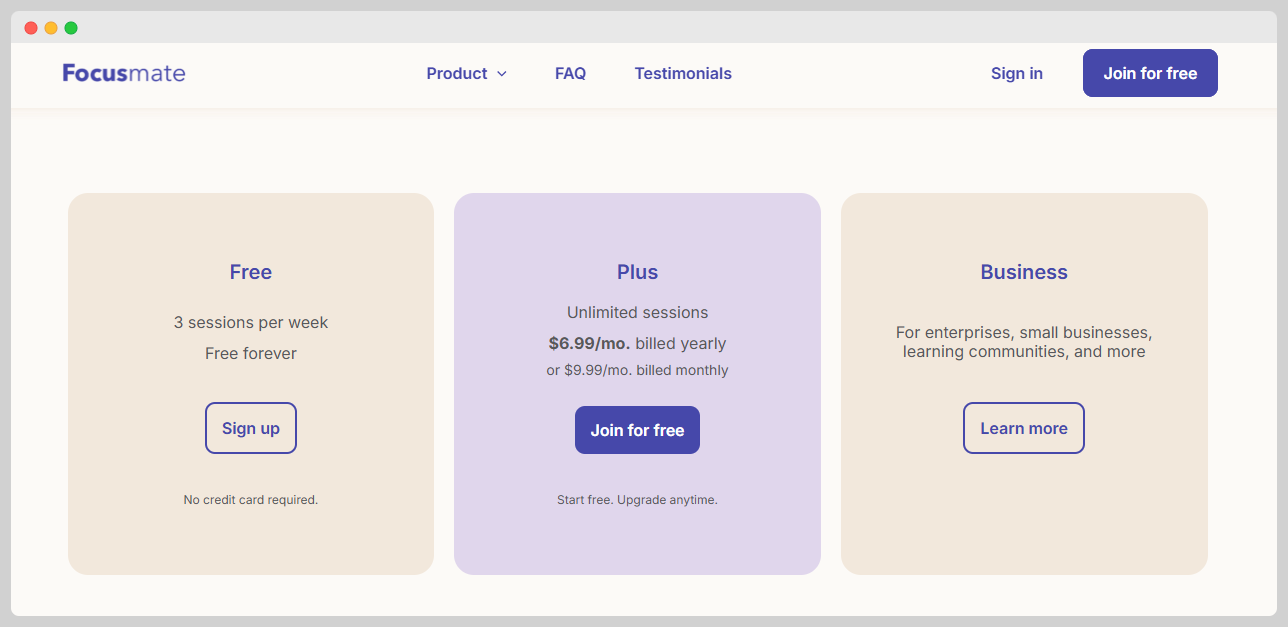
Focusmate is completely free for up to three sessions per week. Users can upgrade to Focusmate Plus anytime for unlimited sessions starting @ $6.99 a month (billed yearly) or $9.99 a month (billed monthly).
What were the biggest lessons learned from building Focusmate?
- Create Community Before Product: Focusmate succeeded by initially bringing people together in a Facebook group to validate the idea, showing that community-driven growth can be a powerful tool.
- Simplify and Iterate: The initial product used a simple, no-code setup with tools like Google Sheets and Zapier, demonstrating that starting simple and iterating based on user feedback is effective.
- Address Real Pain Points: By focusing on a common struggle—procrastination and lack of accountability—Focusmate ensured it was solving a meaningful problem for its users.
- Stay True to Core Values: Taylor Jacobson emphasized mission-aligned growth and maintained a strong company culture, teaching that long-term success often requires commitment to core values over quick wins.
- Use Feedback Wisely: Introducing a paid model after thorough validation allowed Focusmate to receive more serious user feedback, showing the importance of charging for services to refine value propositions.
What platform/tools does Focusmate use?
Focusmate Acquisition: How much did Focusmate sell for and what was the acquisition price?
Focusmate has not yet reported any exit details such as acquisition or sale, according to the provided sources.
Discover Similar Business Ideas Like Focusmate






More about Focusmate:
Who is the owner of Focusmate?
Taylor Jacobson is the founder of Focusmate.
When did Taylor Jacobson start Focusmate?
2017
What is Taylor Jacobson's net worth?
Taylor Jacobson's business makes an average of $83K/month.
How much money has Taylor Jacobson made from Focusmate?
Taylor Jacobson started the business in 2017, and currently makes an average of $996K/year.
Sources (62)