How a Visionary Built Synthesia to $62M Revenue and 55K Customers

Who is Victor Riparbelli?
Victor Riparbelli, co-founder and CEO of Synthesia, hails from Denmark and has a background in technology and artificial intelligence. Prior to founding Synthesia in 2017, Riparbelli moved to London in 2016 with a desire to explore emerging technologies, particularly focusing on the potential of generative AI to revolutionize media production.
What problem does Synthesia solve?
Synthesia helps businesses create professional videos without needing specialized equipment or expertise, saving time and reducing costs while providing a scalable way to communicate and engage with audiences.
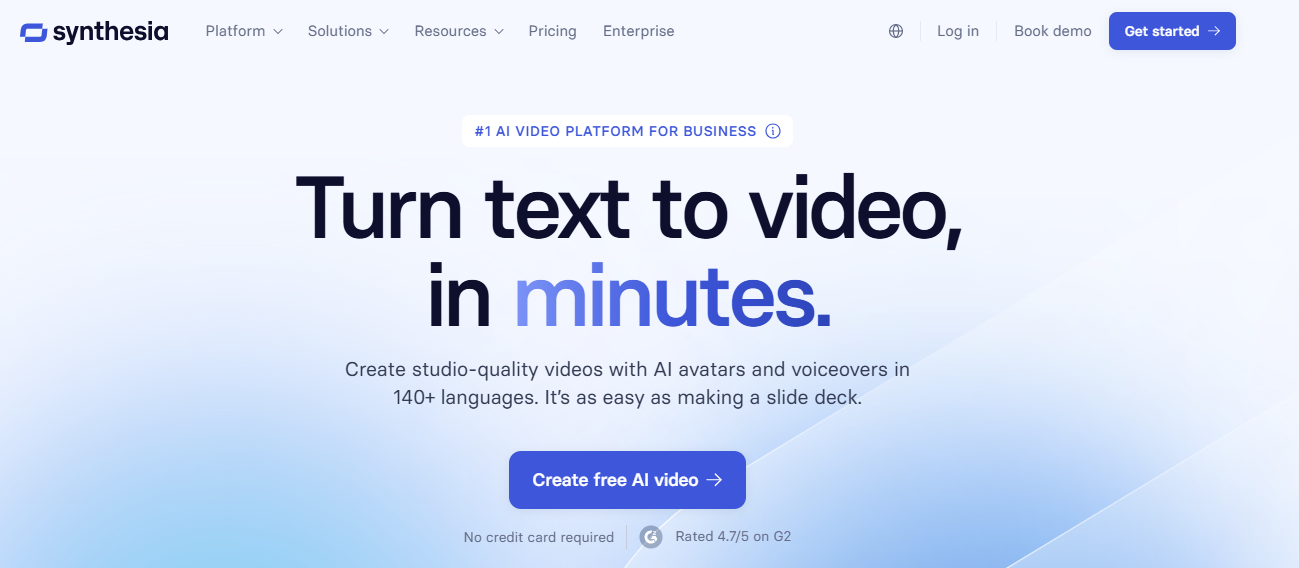
Synthesia.io Homepage
How did Victor come up with the idea for Synthesia?
Victor Riparbelli, inspired by the emerging possibilities of artificial intelligence, founded Synthesia based on a groundbreaking research paper he came across in 2016. The paper demonstrated early uses of neural networks to create realistic video frames. This piqued Victor's imagination, as he envisioned a world where creating intricate video content could be as straightforward as typing up a document.
He spent considerable time exploring various ideas and collaborating with like-minded individuals interested in deep tech innovations like virtual reality. Even after facing initial skepticism and difficulty in securing funding, he remained steadfast. Victor's early focus was on video dubbing, but he quickly realized that the real impact lay in democratizing video production for the masses, not just the film industry. This meant anyone could create professional videos without physical constraints, facilitating a transition from text to video communication.
Through trial and error, Victor and his team fine-tuned their ideas based on market feedback, recognizing the massive potential in transforming traditional text-based communication, like training manuals, into engaging videos. This approach opened up video creation to a whole new audience, building a strong product-market fit that catalyzed Synthesia's growth.
How did Victor Riparbelli build the initial version of Synthesia?
Synthesia was developed by leveraging the potential of neural networks to generate highly realistic video frames, fundamentally changing media production. In 2016, the company's core idea was tested when Victor Riparbelli encountered a research paper about the capabilities of these technologies, indicating a future where video creation could be as accessible as writing text. The initial prototype focused on AI video dubbing, translating existing videos into different languages by altering lip shapes and voiceovers, which was complex and required significant computational power. Over time, the product evolved significantly, with the company's tech stack expanding to include machine learning models and large-scale data processing technologies to enhance avatar realism and communication throughput. The process was challenging, faced with the technological limitation of early avatars appearing stiff, especially with emotional expressions. However, Synthesia's persistent focus on enterprise use cases, like training and internal communication, helped refine their offering and attract a wide user base, allowing for continuous iteration and improvement fueled by customer feedback.
What were the initial startup costs for Synthesia?
- Funding: Synthesia has raised over $250 million, including a $100 million Series D round led by NEA.
- Initial Investments: The company's first funding round was $1 million at a $5 million post-money valuation, with an investment from Mark Cuban.
How did Victor launch Synthesia and get initial traction?
Direct Outreach
In the early days, Synthesia founders engaged directly with potential customers to introduce their technology. They personally approached video production agencies and companies that utilized video for training and marketing purposes. This involved pitching the technology and demonstrating its capabilities.
Why it worked: Direct engagement allowed the founders to gather firsthand feedback and refine their pitch based on the responses they received. By building relationships with the customers, they established trust and credibility, which helped to generate initial interest in Synthesia’s offerings.
Pilot Projects
The founders offered pilot projects to prominent companies, allowing them to test the technology without full commitments. For instance, they worked on a few celebrity endorsement projects where the ability to dub videos with AI was showcased. By providing this as a free or low-cost service, they aimed to demonstrate the effectiveness and capabilities of their platform.
Why it worked: These pilot projects provided tangible examples of the product's value, convincing potential customers of its effectiveness. When companies saw positive results, they were more inclined to promote Synthesia within their networks and consider larger partnerships.
Viral Marketing through User-Generated Content
As the product became more accessible, initially through limited self-service capabilities, users began to create videos and share them widely on social media platforms, particularly TikTok. The platform's ease of use attracted individual creators and businesses who generated buzz around their creations and shared their experiences.
Why it worked: User-generated content served as organic testimonials for Synthesia, showcasing the versatility and fun aspects of the platform. This led to a viral loop where more users got curious about the product, significantly amplifying visibility and awareness without traditional marketing.
Content Collaboration with Influencers
Recognizing the influence of creators in establishing brand credibility, Synthesia partnered with content creators and influencers to extend their reach. They collaborated on examples showing how to use the platform creatively, integrating it into storytelling and educational formats.
Why it worked: Collaborating with influencers who had established followings helped Synthesia tap into pre-existing audiences. This strategy effectively positioned Synthesia as a tool that could be creatively utilized, thus enhancing its appeal among potential users across various industries.
What was the growth strategy for Synthesia and how did they scale?
Viral Growth and Influencer Engagement
One of Synthesia's primary growth channels has been viral marketing, notably when TikTok influencers started creating viral videos using Synthesia, garnering tens of millions of views. This growth loop was further fueled by users sharing their created videos with others, leading to more discoveries and usage.
Why it worked: Influencers have a massive reach and credibility, which helps quickly amplify awareness and adoption of new technologies. TikTok’s algorithm is designed to prioritize engaging and novel content, which was in Synthesia's favor. The ease with which users could create and share videos with their network promoted an organic growth cycle.
Enterprise Sales Strategy
Synthesia targeted enterprise clients early on, which is atypical for companies leveraging product-led growth strategies. By focusing on selling to enterprises, they tapped into recurring and sticky use cases such as employee training and internal communications, where video content offers higher retention and engagement compared to text.
Why it worked: Enterprise clients offer greater revenue potential through larger contracts and recurring usage patterns. Targeting established businesses with clear needs for scalable video solutions meant Synthesia could grow its revenue considerably while also building strong, loyal relationships with significant players in the market.
Self-Service SaaS with Upsell to Enterprise
Synthesia started with a self-service SaaS model that allowed smaller teams and businesses to easily create AI videos. This model leads to the wider adoption of their technology and serves as an onboarding funnel, feeding leads into the enterprise sales pipeline as organizations scale their usage.
Why it worked: This dual approach expanded Synthesia’s reach, capturing a broad user base that different potential enterprise customers come from. Many large-scale contracts often began as smaller self-service adoptions that later upgraded, ensuring that the transition from individual users to enterprise contracts was both natural and effective.
Strategic Use of AI and Automation
By developing a comprehensive AI video platform, Synthesia allowed customers to turn text into high-quality videos with minimal effort, effectively democratizing video production. Synthesia also leveraged large language models to streamline processes like scriptwriting, which amplified their solution's usability and appeal.
Why it worked: Automating labor-intensive processes like video production caters to a massive pain point for businesses—efficiency and cost. By reducing the complexities of video production and editing, Synthesia provided a higher value proposition, resulting in an increased willingness to adopt their technology.
What's the pricing strategy for Synthesia?
Synthesia offers an AI-driven video creation platform with pricing starting at $30/month for individual users, scaling up for enterprise needs, featuring AI avatars for video content generation.
What were the biggest lessons learned from building Synthesia?
- Innovate to Solve Real Problems: Synthesia shifted from serving advertising agencies to addressing the broader need of making video production accessible to all. This pivot from focusing on a niche market to targeting a universal need allowed them to develop a product that replaces text with video, thus solving a widespread communication challenge.
- Leverage AI for Scalability: By utilizing AI for creating videos, Synthesia has drastically reduced the cost and complexity involved in video production. This approach not only democratizes video content creation but also enables scalability, allowing even small businesses to use video as a communication tool.
- Combine Tech with Workflow Efficiency: Synthesia didn't just focus on the AI aspect but also enhanced the overall user workflow by integrating features like scriptwriting assistance through LLM APIs. This made their product a one-stop solution for video creation, emphasizing utility over novelty.
- Focus on Clean, Compliant Data: Synthesia prioritized training their AI on clean and compliant data, despite the challenges, to ensure enterprise trust and ethical standards. This foresight in data handling is crucial for long-term viability, especially as data regulation becomes more stringent.
- Build for the Future: Synthesia's vision of replacing text with video is a forward-looking approach that positions them well as digital content consumption habits evolve. By anticipating the shift towards more video-based communication, they are setting the groundwork for future growth and relevance.
Discover Similar Business Ideas Like Synthesia







More about Synthesia:
Who is the owner of Synthesia?
Victor Riparbelli is the founder of Synthesia.
When did Victor Riparbelli start Synthesia?
2017
What is Victor Riparbelli's net worth?
Victor Riparbelli's business makes an average of $8.33M/month.
How much money has Victor Riparbelli made from Synthesia?
Victor Riparbelli started the business in 2017, and currently makes an average of $100M/year.