How My Sports Platform Makes Over $1M System Revenue Per Month
Who are you and what business did you start?
Who are you and what business did you start? My name is Ruslan Bashirov, and I am the founder of Sportika Labs. We built an all-in-one platform that allows people to launch and grow youth sports academies with full operational support in the US.
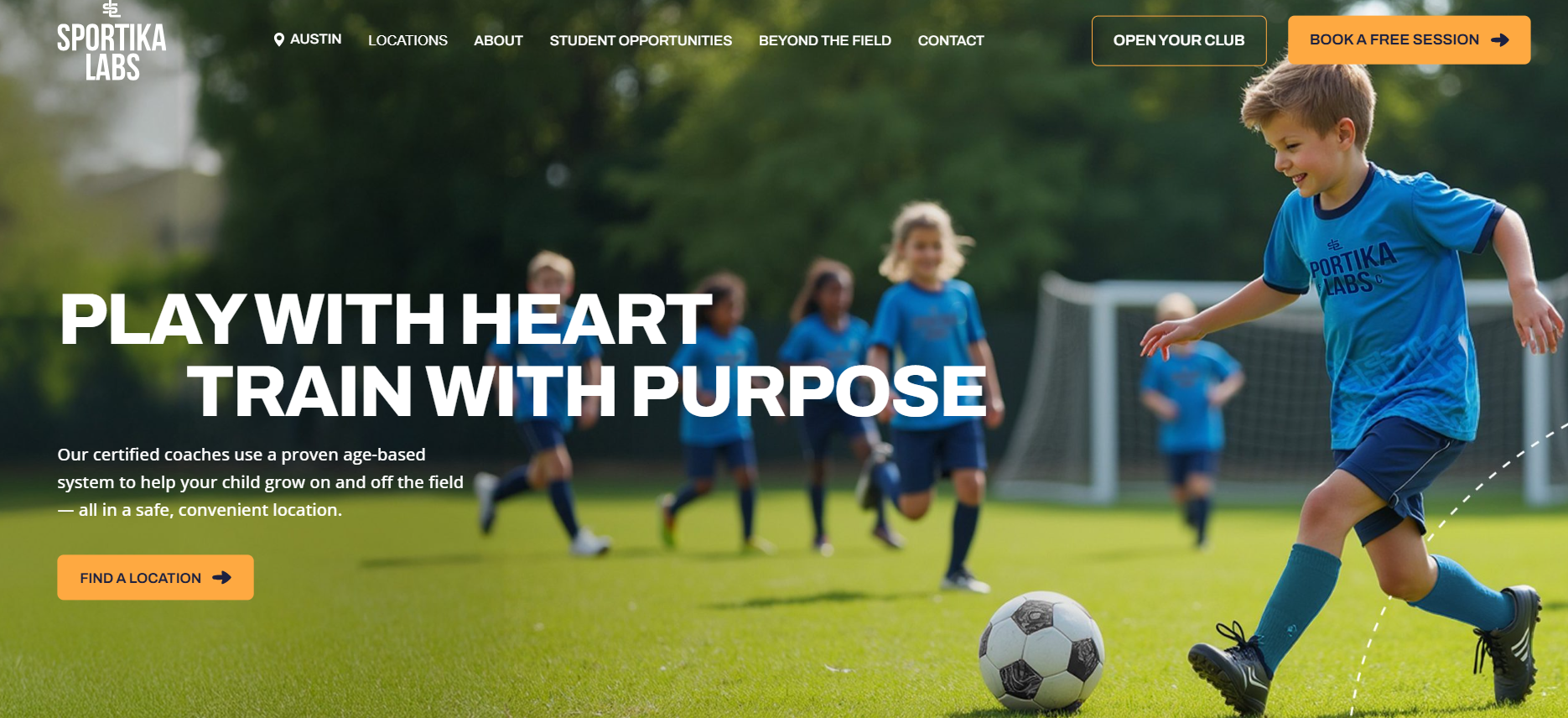
What is the name of your business and who are your primary customers? Our business is called Sportika Labs. We started as a youth sports academy network in Europe and now operate as a B2B2C platform in the US. Our primary customers are people who want to launch or scale a youth soccer academy - including coaches, former athletes, parents, and entrepreneurs. On the other side, we also work with clubs, sports organizations, and athletes who want to build structured youth academy networks under their brand in the US.
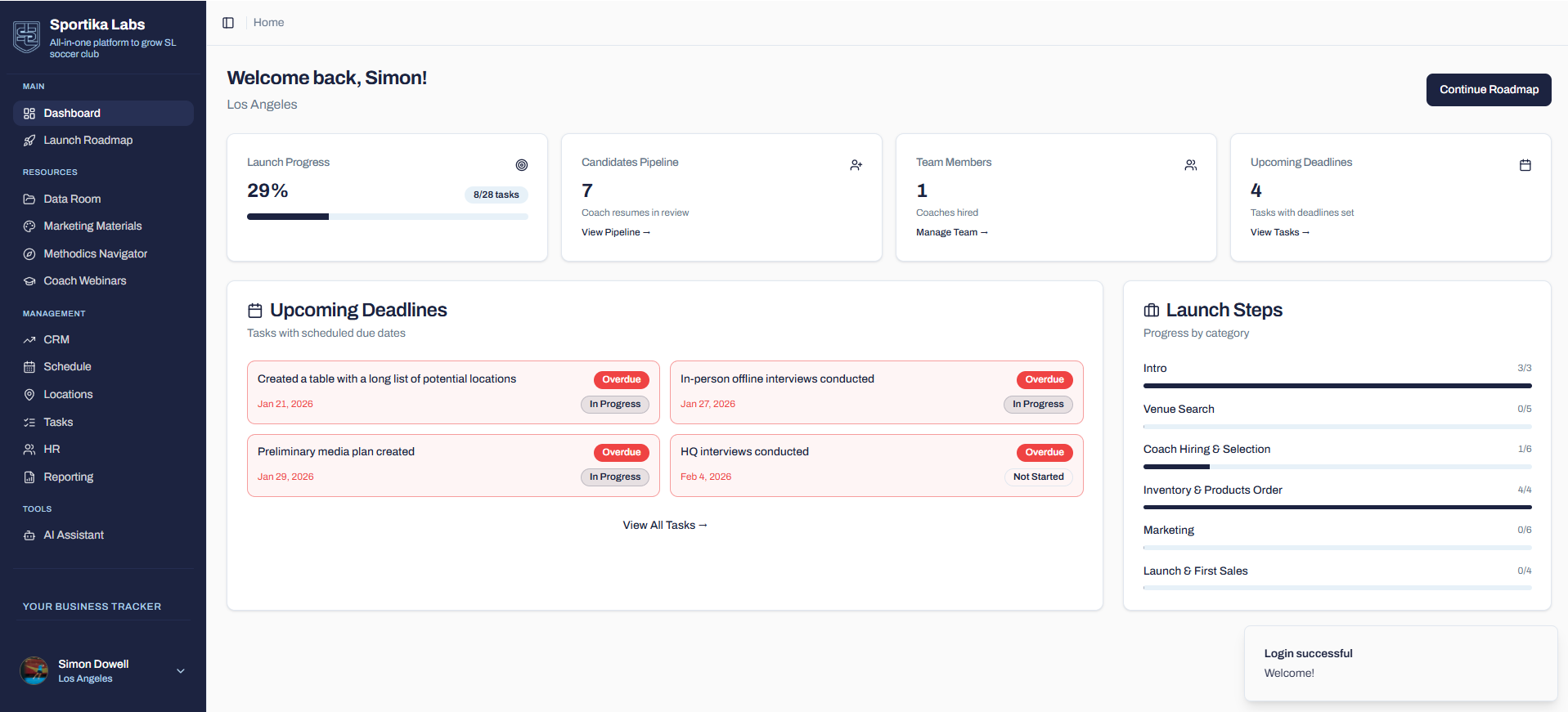
What makes your business unique and/or special? What makes us unique is that we solve the entire problem through one platform and operational support. We provide everything needed to launch and run an academy: from finding locations and hiring coaches to marketing, lead generation, and daily operations. In addition, we connect the U.S. market with top European sports directors and methodology from leading football academies, making professional-level training accessible at scale. The platform also integrates AI tools for player development tracking and provides ongoing support through business trackers, which allows partners to turn an idea into a working business. In other words, Sportika Labs brings rich European experience into the US market which is now more than ready to accept it.
Provide one line about your revenue. Across our network, academies generate around $15M in annual revenue, and we monetize through a combination of fixed fees and a percentage of partner revenue.

My image
How do you come up with the idea for Sportika Labs?
How did you come up with your idea? The idea to enter the US market came after conversations with European football clubs and agencies. We had experience scaling youth academies both under our own brand and in partnership with football clubs, basketball organizations, and athletes with multi-million audiences. One of the top managers from a Champions League-level club was very satisfied with our work and introduced us to several leading clubs in Italy, England, and Spain. Through these conversations, we saw consistent interest in launching structured academy networks in the US.
How did you come up with your business idea? We combined that market insight with clear demand signals in the US: growing interest in soccer, the upcoming World Cup, strong engagement from Hispanic audiences, and youth participation trends. It became clear that this market is large and still underserved in terms of structured solutions.
How did you know this was the right idea to work on? We validated it quickly through demand. After launching initial ads, we saw a very high volume of inbound interest at a low cost. As founders, we even ran into what we call an “overload of leads” - too many people wanted to launch academies in their local areas, from small towns to large cities. That was a strong signal that the demand exists and is not yet fully structured.
Was there an "aha" moment? Yes, when we saw how inexpensive it was to acquire qualified leads and how many people were ready to engage immediately. Some were even ready to move forward before we had a fully localized product.
How was this different from other business ideas you had? This was not a completely new direction but an expansion of an already proven model. The difference was applying it to a much larger and less structured market, where the gap between demand and infrastructure is even more visible.
What is your expertise/background related to your business? I have experience launching and scaling youth sports projects across multiple markets. I was included in Forbes 30 Under 30 for this work, and we have collaborated with professional clubs, federations, and athletes, which gave us a deep operational understanding of this space.
How did you validate your idea? We validated it in two ways. First, through performance marketing and inbound demand. Second, by launching a pilot academy and testing the full model end-to-end, including lead generation, conversion, and operations.
How did you build the initial version of Sportika Labs?
The specific development process of Sportika Labs involved building an all-in-one platform for launching and growing youth sports academies. They utilized a tech stack that included AI tools for player development tracking and business trackers for ongoing support. The first prototype of the platform focused on finding locations, hiring coaches, marketing, and daily operations, which underwent testing and iteration before launch. It took a few months to build the first version, with challenges including manual execution of processes and the need for constant iteration to align with the market demands.
How did you launch Sportika Labs and get initial traction?
How did you 'launch' the business? We launched by going directly to the market with a clear offer: start or upgrade your soccer academy using our platform. At the same time, we began building the first pilot location.
How did you tell the world you were in business? Primarily through digital channels. We used targeted ads, community outreach, and our existing network from previous markets.
What tactics or strategies did you use to get the word out? Performance marketing was the main driver. We also leveraged founder-led outreach, community groups, and referrals from people who already knew our work in other regions.
How did people respond to your launch? The response was very strong. We received a high volume of applications, to the point where we initially had more leads than our team could process.
What lesson did you learn from your launch? What would you do the same or different? We would definitely use performance marketing again as a fast validation tool. What we would do differently is build the team faster and prepare better for scaling inbound demand.
Share the story behind making your first dollar or making your first sale. Our first revenue came from early partners who already trusted us from previous markets. These were not scalable channels, but they were critical to getting initial traction and proving the model. In many ways, it was exactly what Y Combinator often advises - doing things that don’t scale in the beginning to validate the business.
How did you attract your first few clients? Through direct relationships and trust. These were people who understood the space and saw the value of what we were building early on.
How long did it take to make your first dollar? It took a few months to close the first partner in the US market. After launch, their academy started running sessions, and we began earning a percentage of their revenue through our platform and operational support.
What lessons did you learn about yourself or the business? I learned that entering a new market requires switching fully into a startup mindset. You need to move fast, test constantly, and be comfortable with changing processes and rebuilding parts of the system as you go.
What was the growth strategy for Sportika Labs and how did you scale?
How have you grown your business? We have grown through a combination of scalable and non-scalable channels. On the scalable side, we use social media advertising, primarily Instagram and Facebook, where we test audiences and languages across the US. At the same time, we rely heavily on trust-based channels such as personal networks and communities - WhatsApp, Telegram, Facebook groups, and coaching networks. Another important factor is hiring. Early-stage growth is highly dependent on the team, so we focus on hiring strong, motivated people with relevant experience. For example, we hired a Head of Sales from a leading US EdTech company, Careerist, who had experience scaling a sales team to 30+ people. We also saw strong demand from Spanish-speaking audiences early on, which led us to quickly adapt and hire Spanish-speaking sales managers.
What tactics or strategies have you used to get more customers? (SEO, social media, PR, newsletters, knocking on doors, etc.) We use a combination of performance marketing, community outreach, and structured sales funnels. Paid acquisition happens mainly through Instagram and Facebook, while community channels help with trust and conversion. Once a lead enters our system, they go through a structured funnel that includes email nurturing, a live product demo, access to materials, and conversations with existing partners. In addition, we actively use AI tools to improve sales efficiency. For example, we built an AI tool that analyzes a potential partner’s goals and builds a financial model based on real data - including rent, coach salaries, pricing, and customer acquisition costs in a specific state. We also have an AI tool that scans and ranks potential training locations in a partner’s area, generating a shortlist of the most promising options. These tools help us focus on high-quality partners and accelerate decision-making.
What channels have you used to grow your business? (Twitter, Reddit, newsletter, media, Facebook, etc.) Why did you use this channel? We primarily use Instagram and Facebook for scalable paid acquisition because these platforms allow precise targeting and fast experimentation with different audiences in the United States. We also use personal networks, including WhatsApp, Telegram, and Facebook groups, because these channels are highly effective for trust-based communication and convert very well in niche communities. In addition, we engage with coaching and local sports communities, since they already consist of our ideal target audience. We use each channel depending on its role, with paid media for scale and community channels for trust and conversion.
Share a real example of a strategy or tactic you used to grow your customer base One concrete example is our Instagram advertising funnel. We use specific creatives in our ads, some of which are also pinned in our Instagram profile. These ads drive users into our CRM system, where they are automatically entered into an email nurturing sequence. After that, they are invited to a live video presentation with our team. During this presentation, we show the platform in detail, including training materials, lesson plans, operational workflows, and real examples of webinars. In addition, potential customers have the opportunity to speak directly with an active licensee in the United States, and they can also speak with me as the founder. This multi-step process significantly improves conversion because it gradually builds understanding and trust.
Why did this strategy/tactic work? What can readers learn from your experience? This strategy works because it combines performance marketing with a structured trust-building system. In our business model, customers are not simply buying a product, but entering into a partnership, which requires a high level of trust. Because of this, it is not enough to generate leads; it is necessary to educate them and reduce uncertainty throughout the entire journey. The funnel works effectively because it shows real evidence, real people, and real operations behind the product. The key lesson is that advertising alone is not enough, and that conversion depends on how well you can educate, validate, and build trust after attracting attention.
Do you have any recommendations on how aspiring entrepreneurs can grow their business? My main recommendation is to combine scalable acquisition channels with non-scalable, high-trust channels. In the early stages, personal networks and communities often perform better than pure paid advertising because trust is the main factor in conversion. At the same time, scalable channels such as social media ads and content distribution become increasingly important once the message and positioning are validated. Another key recommendation is to build a structured funnel early on, because attracting attention is not sufficient on its own. It is essential to have a system that converts attention into trust and trust into action.
My image
What were the biggest lessons learned from building Sportika Labs?
Advice / Through starting the business, have you learned anything particularly helpful or advantageous? One of the most important lessons we learned is that early-stage startups benefit significantly from using non-scalable approaches more than people typically expect. For example, instead of relying only on standard recruiting platforms, we successfully hired key team members through personal recommendations. This approach allowed us to find people with strong experience in the US market and a startup mindset. We learned that in the early stage, it is crucial to prioritize cultural fit, motivation, and relevant experience over purely formal processes. Although this approach requires more time, it leads to significantly stronger long-term outcomes.
Mistakes / poor decisions / challenges / obstacles One of the main challenges we faced is that startups are inherently unstructured in the beginning, and many processes are not yet automated or fully defined. As a result, a significant amount of work requires manual execution and constant iteration. Another major challenge was hiring the right people, especially senior candidates with relevant US market experience who also understand startup dynamics. Additionally, working in a distributed team environment, often with people we have never met in person, creates communication and alignment challenges that require strong systems and trust-building mechanisms.
Good decisions you made One of the key decisions was focusing on trust-based hiring through personal recommendations rather than relying only on traditional recruitment channels. We also built a sales process centered around education and transparency instead of aggressive selling. Another important decision was combining scalable acquisition with community-driven channels. Finally, adopting an AI-first approach across the company became a major advantage. This works best when driven top-down - as a founder, you need to actively use AI tools yourself, demonstrate their value, and get the team excited to adopt them.
Forces out of your control that helped, i.e. luck, timing, trends Several external factors contributed to our growth. The US youth sports market is experiencing strong growth, particularly in soccer, which increases overall demand. There is also a rising interest among parents and organizations in structured sports education programs. In addition, the United States has a strong culture of entrepreneurship, franchising, and licensing, which makes it easier for people to engage with our business model. Another advantage is that our product combines offline delivery with a digital backbone, which allows us to scale without being fully constrained by physical location or local operations.
The lessons you learned, and how you applied them (or could have applied them) We learned that speed and adaptability matter more than perfection. We continuously iterate based on feedback from partners and users. We also learned that trust is the core of our business model, so we invested heavily in transparency - live demos, real case access, and direct communication. Another key principle we follow is focusing on controllable inputs rather than outcomes. Instead of chasing results directly, we build systems and processes that make those results inevitable over time.
Helpful habits/abilities/skills that you possess Some of the most helpful habits include continuous experimentation with marketing channels, a strong focus on system-building, and the consistent use of AI tools across all workflows. We also prioritize direct communication with communities and partners, which helps us stay close to the market. Another important capability is our ability to iterate quickly on product development based on real user feedback rather than assumptions.
Your top tips and learnings; things that might not be obvious One key insight is that non-scalable actions are often the fastest way to achieve early traction and product-market fit. Another important lesson is that trust-building is often more important than traffic generation, especially in partnership-based or licensing models. It is also critical to hire slowly and carefully in the early stage, especially when cultural and mission alignment is important. In addition, combining AI tools with human workflows can significantly increase efficiency and reduce operational costs. Finally, the most effective growth comes from systems rather than isolated campaigns.
Mistakes you often see other people making One common mistake is relying too heavily on advertising without having a strong conversion system in place. Another is attempting to scale too early before achieving clear product-market fit. Many teams also hire too quickly without ensuring cultural alignment or long-term fit. Additionally, founders often underestimate the importance of trust in B2B or partnership-driven models. Finally, many companies delay building proper systems, which results in inefficient manual operations for too long.
Inspire us!!! Building a startup is not about achieving perfection from the beginning, but about learning quickly, adapting continuously, and building systems that compound over time. When you combine scalable growth channels with strong trust-building mechanisms, and leverage modern tools such as AI to increase speed and efficiency, you can create a business that scales far beyond traditional limitations.
Discover Similar Business Ideas Like Sportika Labs


More about Sportika Labs:
Who is the owner of Sportika Labs?
Ruslan Bashirov is the founder of Sportika Labs.
When did Ruslan Bashirov start Sportika Labs?
2025
How much money has Ruslan Bashirov made from Sportika Labs?
Ruslan Bashirov started the business in 2025, and currently makes an average of $15M/year.
More Case Studies Like This





Starter Story × HubSpot
Free tools for every part of your business.
Find customers, win deals, and automate the busywork with HubSpot's free tools.