How I Built A $100K/Month Talent Agency
Who are you and what business did you start?
Daniel Seligman from Toronto, Canada.
First of all, I want to share that I'm a normal person. I don't have a huge social media following, I didn't go to a fancy Ivy League school, and I'm not VC-backed.
I was an employee for multiple companies over a decade, making my way up from an entry-level salesperson to a VP of sales. I finally decided it was time to start my own business and become an entrepreneur. I want to share my story and my business to hopefully inspire someone else to take that leap of faith and live out their dream.
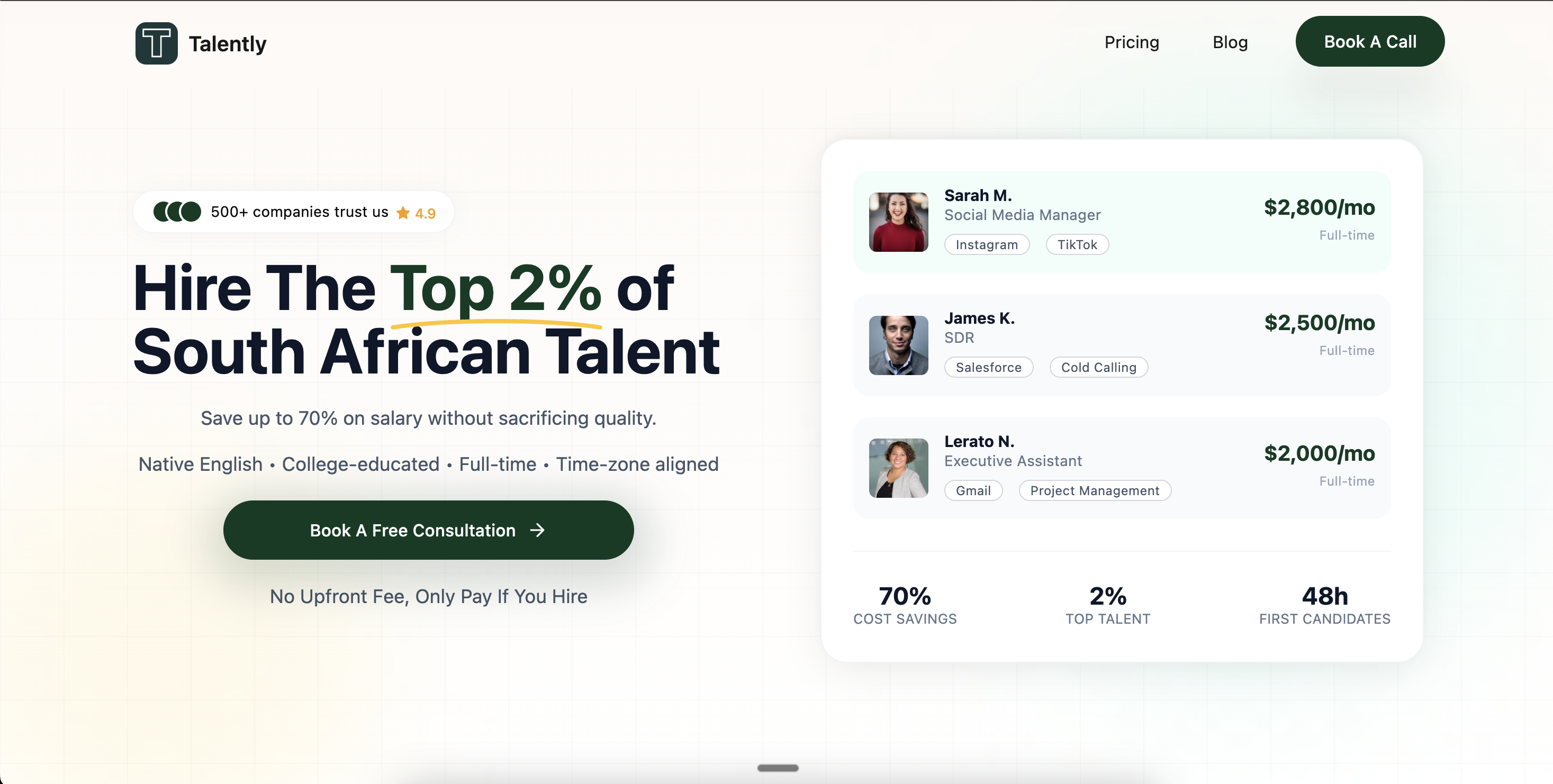
I'm the founder and CEO of Talently. We are the fastest-growing offshore and staffing firm for South African talent.
Our clients are Canadian, American, and UK companies, anywhere from 1 to 300 employees, looking to hire and build incredible sales, marketing, support, and finance talent.
The interesting thing about our business is that, in my previous job, I was exposed to this market before I started the business in it. Hiring remote employees all around the world is an incredible asset to businesses, but there are three common issues that every business owner will run into:
- Language barriers
- Education/Skill deficiency
- Time zones issues
This is something I suffered with personally as a VP in my previous job, so I went out to solve the problem myself. The unique positioning of our business is that we solely focus on South African employees, which solves the three problems above:
- South Africans are Native English speakers
- Incredible education system and business environment
- Only a six-hour time difference from EST, so all the employees work normal hours
I ran the business completely solo for two years, got it to over $2,000,000 in revenue. Now I have one employee to help us scale to the next stage of the business.
We are currently doing over $100,000 per month with 40% net profit margins.
If I can launch and run a successful business, you can too. !
How do you come up with the idea for Talently?
When deciding on a business idea, I approached it in reverse. I made a list of all the things I don't want in the business:
- Raise VC money
- Be geographically limited
- Have a huge team
- Have any sort of inventory
This helped me focus my business brain on where I wanted to go. In my previous company, I was exposed to the offshore staffing recruiting industry directly. We had employees all around the world: Canada, Brazil, Spain, Romania, and the Philippines, and it was a bad experience. I thought to myself, "There might be a better way to do this," and if I can solve my own problems, I'm sure there are other people and businesses that have these problems as well.
With that being said, this was the fifth business that I tried to launch, and the only one that I'm still running successfully today. The previous four businesses were all very valuable learning experiences. Some of them made money, and some of them lost money, but throughout it all, you learn things and take it with you to build your next, hopefully successful, life-changing business.
The only way I knew how to validate a business was to go get a customer. I landed my first three customers using my personal Gmail account, without a website, by reaching out to CEOs of companies that I thought would gain value from our services. Luckily for me, it worked out.
How did you build the initial version of Talently?
- Development and Manufacturing Process: Daniel built the product of Talently through a two-year period running the business completely solo. He focused on hiring South African talent to address language barriers, education/skill deficiencies, and time zone issues that he had personally experienced in his previous job.
- Tools and Software Used: Daniel used his personal Gmail account for initial outreach and landing his first three customers, without a website. He leveraged cold email, LinkedIn outreach, and his personal network to get initial traction for the business.
- First Prototype: The initial prototype of Talently was the service itself, connecting Canadian, American, and UK companies with South African talent. Daniel validated the business by landing his first customers within just over a month of launch, showing the effectiveness of his approach.
- Time to Build First Version: From the launch on January 1, 2024, to landing the first customers and becoming profitable on February 16, 2024, was the turnaround time Daniel needed to build the first version of Talently.
- Experience and Challenges: Daniel's experience of building the product involved focusing on what he was good at and delegating tasks he didn't enjoy. He realized the importance of self-awareness in order to grow the business effectively. Additionally, he emphasized the need for entrepreneurs to understand the game they are playing in business and align their goals accordingly.
How did you launch Talently and get initial traction?
I'm not a marketing person, so I didn't have a grand plan for how to launch the service. I'm a salesperson, so I did what I knew how to do best:
- Outbound: cold emailing people I thought would be a good fit
- Cold LinkedIn connections
- Cold outreach to my personal network to try to get any introduction I could
It worked. My first three clients came from:
- LinkedIn outreach
- Cold email
- My personal network
None of those clients are with us today, but they provided incredible feedback and insights on how to run this business more effectively and helped us get to where we are today. From launch on January 1, 2024, to landing our first customers and becoming profitable on February 16, 2024, was our turnaround time from launch to customer.
My biggest learning early on was that there are very few rules in business. Just go out and try something, see what happens, and then adjust and try it again. At least for me, I always thought business was overly complicated.
- You have to set up an LLC.
- You have to hire an accountant.
- You have to get financing.
If they set up a business account, just focus on the basics:
- Come up with a product or service.
- Go get your first customer.
You'll figure out everything else on the way.
What was the growth strategy for Talently and how did you scale?
Right now, our business is growing:
- 60% through referrals and repeat business
- 30% through cold outbound email and LinkedIn
- 10% from miscellaneous channels such as SEO, Reddit, etc.
For growth, I still think LinkedIn is the most slept-on channel. Less than 1% of LinkedIn users are posting daily, and less than 1% of users are maxing out their connection requests per week. We do both of those things:
- Post valuable content daily to drive engagement and exposure.
- Send 200 personalized connection requests a week to potential customers with direct value.
We have seen these efforts compound significantly over time, so it's about making that effort but also staying consistent.
The other growth channel that has been very successful for us is timely requests. What I mean by that is during our customer experience, there are very specific times when things go well and everybody's very happy, such as when they make their first hire or when a candidate gets a job offer. Those are very important times to request a referral or a Google review, and really make sure that the customers that like you and want to work with you are going out of their way to support you. This has been a huge benefit to us.
For any other aspiring entrepreneurs, they can use these tactics themselves, but the most immediately valuable tactic is leveraging your existing network. People who trust you and like you will go out of their way to support you if you're actually providing value to them or someone in their network. Don't be scared to put yourself out there and be vulnerable to your friends, family, or colleagues, because the majority of the time people will want to support you.
What were the biggest lessons learned from building Talently?
I think I made a very common mistake that a lot of first-time founders and entrepreneurs make is I tried to do everything. I was doing sales, marketing, support finance I'm the founder I have to do everything is what I thought to myself but very quickly I realized there were some things that I dreaded doing and I didn't do well and there are some things that I did very very well and once the business was established i would say about six to eight months in i made a list on the whiteboard above my desk of every task that i did on a weekly basis and i circled the ones in green that i liked doing and thought i was good at and i circled the ones in red that i wasn't good at and i thought i needed to get off my plate after I had that it was very clear how I was going to grow this business delegate everything I didn't like doing such as finance and admin work and focus on the things that I did like working did like doing sales and customer facing communication there was a clear distinction after that process was after I made that decision and the business doubled in the next couple months
I think it's so important to be very self-aware of what you're good at and what you're not good at to make sure that your day-to-day operations are as smooth as possible.
The one other thing that I think every entrepreneur should be very clear about is they should understand what game they are playing. What I mean by that is in business, if you're going to chase becoming a billionaire unicorn company, that game is raising VC money and building a big team and being on that treadmill. If you're looking to run a profitable business, then you might be able to run a service business. If you want to build an amazing e-commerce brand, you have to know that you're going to have to float inventory and deal with SKU's and returns and customer complaints. You have to understand what end goal you're trying to accomplish and then sign up for the game that is going to get you there.
A lot of people think about the company or the service or the product they want to offer, but they don't think about what's at the end of that pursuit. If you think about what you want at the end of the day and what's going to make you happy, I think it's easier to understand what business game you should sign up for, and one that, more importantly, you'll be able to stick with.
Talently Acquisition: How much did Talently sell for and what was the acquisition price?
Not Acquired and don't plan on selling.
Discover Similar Business Ideas Like Talently

More about Talently:
Who is the owner of Talently?
Daniel Seligman is the founder of Talently.
When did Daniel Seligman start Talently?
2024
How much money has Daniel Seligman made from Talently?
Daniel Seligman started the business in 2024, and currently makes an average of $1.24M/year.
More Case Studies Like This




Starter Story × HubSpot
Free tools for every part of your business.
Find customers, win deals, and automate the busywork with HubSpot's free tools.