I Make $2,800 Per Month Fixing Drones
Who are you and what business did you start?
My name is Thomas Lau, and I'm the founder of Reboot Hub — Hong Kong's specialist in chip-level DJI drone repair and Pristine Pre-Owned DJI drones.
I graduated from Ecole Hôtelière de Lausanne (EHL) — consistently ranked the world's #1 hospitality management school — with campuses in Lausanne, Switzerland and Singapore. I trained across properties in Shanghai, Prague, and Singapore, including an operations internship at Marriott International's Regional Office covering Singapore, Malaysia, and the Maldives. My last role was in the marketing department at The Ritz-Carlton Hong Kong. By every external measure, the career was going well.
But I kept coming back to the same thought: I didn't feel like I belonged there. So I made a decision that surprised everyone around me — I quit, moved to Shenzhen, and enrolled in a professional drone repair programme. I came back with a MOHRSS certification (China's highest national credential for drone maintenance technicians) and launched Reboot Hub.
What makes Reboot Hub different isn't one thing — it's the combination:
Genuine DJI OEM parts, always. Every repair uses authentic components sourced directly from DJI. No third-party substitutes.
Pre-owned inventory sourced directly from DJI's own after-sales department. The quality speaks for itself — some units even arrive with an active DJI Care plan still valid, which genuinely surprises customers when they open the box. One customer bought a Mini 3 Pro from us, loved it, came back and bought an Air 3, and is now our most loyal customer.
We carry DJI models you simply can't buy new anymore. Discontinued configurations, limited units, older models still in demand — we're often the only source.
Every transaction is documented on video. Every repair, every drone we ship comes with a full video report sent to the customer before dispatch. That's something I carried over from hospitality training — a relentless focus on quality and making every customer feel certain about what they're receiving.
My customers are drone enthusiasts worldwide — hobbyists, content creators, and professionals based mostly in the UK, Europe, North America, and Southeast Asia.
Today, Reboot Hub brings in around $2,800/month — with zero paid advertising. For anyone who's run an e-commerce business, that context matters.
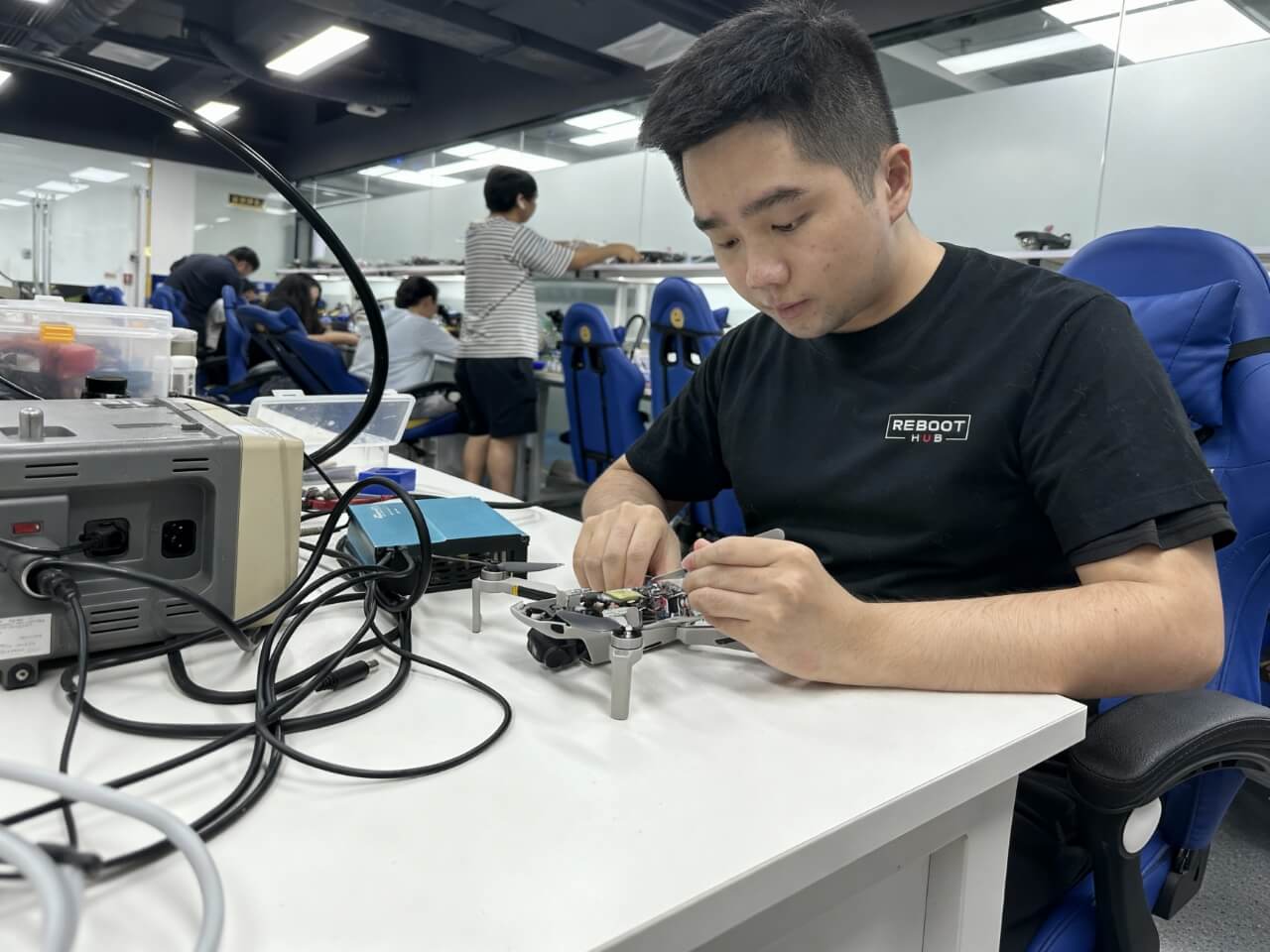
Reboot Hub Founder, Thomas Lau
How do you come up with the idea for Reboot Hub?
The idea came from a family conversation — not a business meeting, not a market research report. My family was talking about China's newly announced
"low-altitude economy" policy, which was fuelling a boom in drone adoption, training, and manufacturing. I started asking a different question: what
happens to all these drones when they break down — especially for owners outside of mainland China?
I spent a few days researching it properly. What I found was stark. Forums like Reddit's r/drones were full of people stuck with broken DJI drones and no good options. DJI's official repair process was either unavailable in their country, slow, or quoted them a price close to buying a replacement. Third-party repair shops lacked the parts, the certification, or both. The pre-owned market was a lottery — no standard, no warranty, no accountability.
The "aha" moment wasn't a flash of inspiration. It was more like the slow realisation that this gap was real, structural, and that nobody was solving it properly — not because it was impossible, but because the barrier to entry was genuine expertise. You need the right certification, the right supply chain, and the right operational discipline to do it well.
That last part is where my background became relevant in ways I hadn't expected. Five years of hospitality training at EHL and across Marriott, Ritz-Carlton, Peninsula, and InterContinental didn't teach me to fix circuit boards — but it drilled into me something harder to learn: how to build trust with a customer who is handing you something expensive and hoping you don't disappoint them. Every video report, every condition disclosure, every grading standard we publish comes from that mindset.
I validated the idea, the only way that made sense: I went to Shenzhen and trained. If the repair work was too hard, too inconsistent, or the supply chain wasn't real, I'd know before spending anything on a storefront. The MOHRSS certification wasn't just a credential — it was the validation process. Being able to source inventory directly from DJI's after-sales department was the second confirmation that the supply side was real.
I'd had other business ideas before — most of them required significant ad spend to get off the ground, or were entering crowded markets where differentiation would be slow and expensive. This was different: genuine scarcity on the supply side, a real expertise moat, and customers who were already searching and already frustrated.
How did you build the initial version of Reboot Hub?
Thomas Lau built Reboot Hub by first enrolling in a professional drone repair program in Shenzhen and obtaining the MOHRSS certification for drone maintenance technicians. He sourced genuine DJI OEM parts directly from DJI and pre-owned inventory from DJI's after-sales department. The first prototype of the business involved repairing and selling DJI drones with a focus on quality and authenticity, which was a process that required genuine expertise, the right certification, and a reliable supply chain. Lau used AI tools such as n8n for workflow automation and Claude Code for tasks like SEO automation, bulk data processing, and API integrations to streamline operations and eliminate manual processes. The development of the first version of Reboot Hub took months of training and certification, as well as setting up automated systems to handle various tasks efficiently and effectively. Overall, Lau faced challenges in building the business, particularly in automating processes and sourcing authentic parts, but his expertise, dedication to quality, and strategic use of technology tools contributed to the successful development of Reboot Hub.
How did you launch Reboot Hub and get initial traction?
I didn't launch with a press release or a big announcement. I built the store, made sure the fundamentals were solid, and started from zero — which, for me, looked very different from my previous attempts at running an online business.
This is my fourth time trying to build something. Before Reboot Hub, I ran a pet products store on Shopify. It taught me a lot — mostly through pain. Everything was done manually by me: product listings, descriptions, customer emails, and logistics tracking. I had no coding background, and building anything beyond basic Shopify customisation meant either hiring someone or spending days figuring it out myself. It was exhausting, and the business didn't survive.
The difference this time was AI.
When I started Reboot Hub, I began using n8n for workflow automation and web-based AI tools to handle tasks that would have taken me days. It felt like gaining an extra brain — one that doesn't sleep, doesn't get bored of repetitive tasks, and can draft, edit, and structure faster than I can think. Then I started using Claude Code, and things shifted again. Suddenly, tasks that required a developer — SEO automation, bulk data processing, API integrations — I could do myself. The entire SEO pipeline running on this store today was built that way: automated, systematic, and running daily without me touching it.
For founders who aren't technical: I had never written a line of code before this business. AI didn't just save me time. It removed a ceiling I thought was fixed.
The first customer.
My first sale wasn't from an ad or a Google search. It was an expat living in Hong Kong whose DJI drone had broken down. He found us, and because he was living in Hong Kong, we met in person — I picked up the drone directly, took it back to our repair base, filmed the full diagnostic process, and sent him a written report. Two days later, it was fixed and back in his hands.
He was genuinely surprised. Not just that it was fast, but that the whole process — the video, the report, the communication — was professional in a way he hadn't expected from a small operation. He left us a five-star review on Trustpilot. That first review mattered more than any ad spend would have.
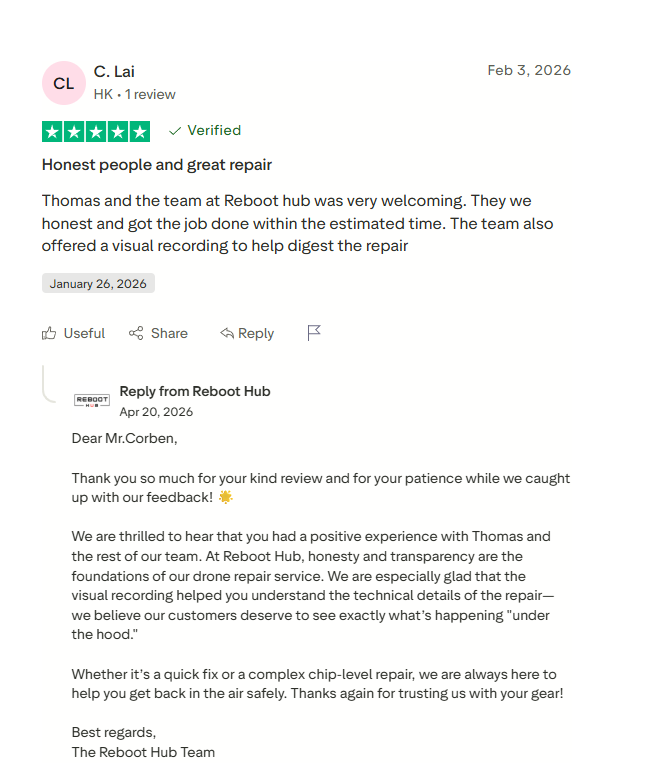
The first Trustpilot review for Reboot Hub
The first order came in the third month after the store went live. I won't pretend that felt fast — it didn't. But I've been through enough failed attempts to know that the accumulation period is real, and there's no shortcut through it.
What I've come to believe — and this is something I've had to learn more than once — is that the people who succeed at building businesses aren't necessarily the smartest people in the room. They're the most resilient. The ones who keep moving when there's no visible path forward, when the metrics are flat, when nobody is watching. The path gets built by walking it.
I believe in this product and this brand. That belief isn't blind optimism — it's been tested by the earlier failures. And it's what keeps the work going on the days when nothing seems to be moving.
What was the growth strategy for Reboot Hub and how did you scale?
Almost entirely through SEO — and an AI-powered content pipeline I built myself.
Early on I made a deliberate decision: no paid advertising. Partly because I didn't have the budget to burn, but mostly because I'd watched enough e-commerce businesses become completely dependent on Meta or Google Ads spend to survive. I wanted to build something where the traffic compounds over time, not something that stops the moment you stop paying.
The SEO strategy has three layers.
The first is product and collection architecture. Every product listing, every collection page, and every title was structured around how real customers search — not just "DJI Mavic 3 Pro" but "pre-owned DJI Mavic 3 Pro", "refurbished DJI Air 3S", "DJI drone repair Hong Kong". We standardised over 150 product titles and meta descriptions to match actual search intent.
The second is authoritative content. We published a public, defined, citable standard for grading usedDJI drones, it's free to reference and is designed to be the industry reference point for anyone writing about pre-owned DJI drones. That kind of content earns links naturally over time.
The third layer is pillar articles — long-form, structured content built around the questions real buyers and repair customers ask. Each one is built with FAQPage schema so it's formatted for both Google and AI search engines like Perplexity and ChatGPT. This matters more than most people realise: a growing share of product and service discovery now happens through AI-generated answers, and if your content isn't structured to be cited, it won't be.
The part that made all of this possible: AI.
I have no technical background. Before this business, building and maintaining a content-heavy Shopify store meant doing everything manually — one listing, one article, one redirect at a time. With AI tools (I use Claude Code heavily for this), I was able to build automated systems: bulk content generation, schema injection across all pages, internal link management, and translation pipelines for multiple languages. What would have taken months of agency fees or developer time, I built and maintain myself.
A concrete example: our entire SEO content pipeline runs automatically every day via a scheduled task. It monitors content gaps, generates structured articles, injects schema markup, and manages internal linking — without me touching it each time. That's the kind of leverage that lets a one-person The operation competes with established players.
Grow Business Channel: Media coverage.
In November 2025, our story was featured in one of Hong Kong's leading newspapers — as part of a feature on Hong Kong's drone repair industry. We didn't pitch it. The coverage came from being genuinely active in the space and being findable when journalists go looking.
What's worked: trust signals over traffic hacks.
You'll find plenty of advice online telling you to seed your own reviews, ask friends to write them, or manufacture social proof to "get the ball
rolling." We never did that. Every five-star on our Trustpilot page is from a real customer who had a real experience — the video report, the fast turnaround, the condition of the drone when it arrived. We didn't engineer the reviews. We engineered the
experience, and let the reviews follow.
For aspiring entrepreneurs:
Don't start with paid ads if you can avoid it. They'll teach you acquisition but they'll also hide whether your product is actually good. Start with SEO and word of mouth — it's slower, but every result you get tells you something true about whether what you're building has real demand. And if you're not technical, stop using that as a reason to delay. The tools exist today to build sophisticated systems without writing a single line of code yourself.
What were the biggest lessons learned from building Reboot Hub?
The mistake that taught me the most.
My previous business — a Shopify store selling pet products — failed. Not because the market was wrong, but because I was trying to build something sophisticated with entirely manual processes and no real competitive edge. Every product listing, every update, every customer email was done by hand. I was busy but not building anything that compounded. When I started Reboot Hub, I made a rule: if I'm doing the same task more than twice, I need to find a way to automate it.
The best decision I made: going to learn the trade before selling anything.
A lot of people launch first and figure out the product later. I spent months in Shenzhen training before a single listing went live. Getting certified wasn't just about credentials — it meant I genuinely understood what I was selling and repairing. That knowledge changes everything: how you write product descriptions, how you diagnose problems, how you answer customer questions, how you spot a drone that's been tampered with. You can't fake expertise, and you shouldn't try.
The thing I didn't expect: AI changed what's possible for a solo founder.
I am not a developer. I had never written code before this business. And yet today, Reboot Hub runs a fully automated SEO content pipeline, multi-language translation systems, schema injection across hundreds of pages, and bulk data processing — all built and maintained by me, using AI tools. When people say "AI is just a productivity boost," they're underselling it. For a non-technical founder, AI removed a ceiling that would have otherwise cost tens of thousands of dollars in developer fees or years of learning. My advice: stop treating AI as a writing assistant and start treating it as a co-founder who can build systems.
Timing and forces I didn't control.
China's "low-altitude economy" policy created a wave of interest, training, and investment in the drone industry. I didn't predict it — I was already paying attention to the space and moved when I saw it. The overseas repair gap I identified had existed for years. The timing of AI tools maturing made it possible to build the systems I needed. Luck matters, but luck only pays off if you're already in motion when it arrives.
The mistakes I see other founders make.
Relying on paid advertising before knowing if their product actually works. Ads can manufacture traffic — they can't manufacture trust. If your product isn't good enough to generate word of mouth at small scale, more traffic won't save it.
Chasing social proof shortcuts. Seeded reviews, inflated numbers, manufactured credibility. It works until it doesn't — and when it collapses, it takes everything with it. Build the experience. The proof follows.
Waiting until they feel "ready." This is my third or fourth attempt at building a business. The earlier ones failed. Each failure was expensive and humbling and completely necessary. There is no version of entrepreneurship where you skip the difficult early period. The only variable is whether you learn from it or let it stop you.
The thing I keep coming back to.
The entrepreneurs I've seen succeed aren't the most talented people I've encountered. They're the most resilient. The ones who kept moving when nothing was working, when the metrics were flat, when the idea seemed crazy to everyone around them. The path doesn't appear before you start walking. It gets made by walking.
I left a career at The Ritz-Carlton, one of the world's most recognised luxury brands, with an EHL degree and a clear trajectory — and traded it for a workbench in Hong Kong and a drone repair certification from Shenzhen. Most people thought I was making a mistake.
Build the thing you believe in. Move before you're ready. Stay longer than feels reasonable. The compounding happens — you just have to still be there when it does.
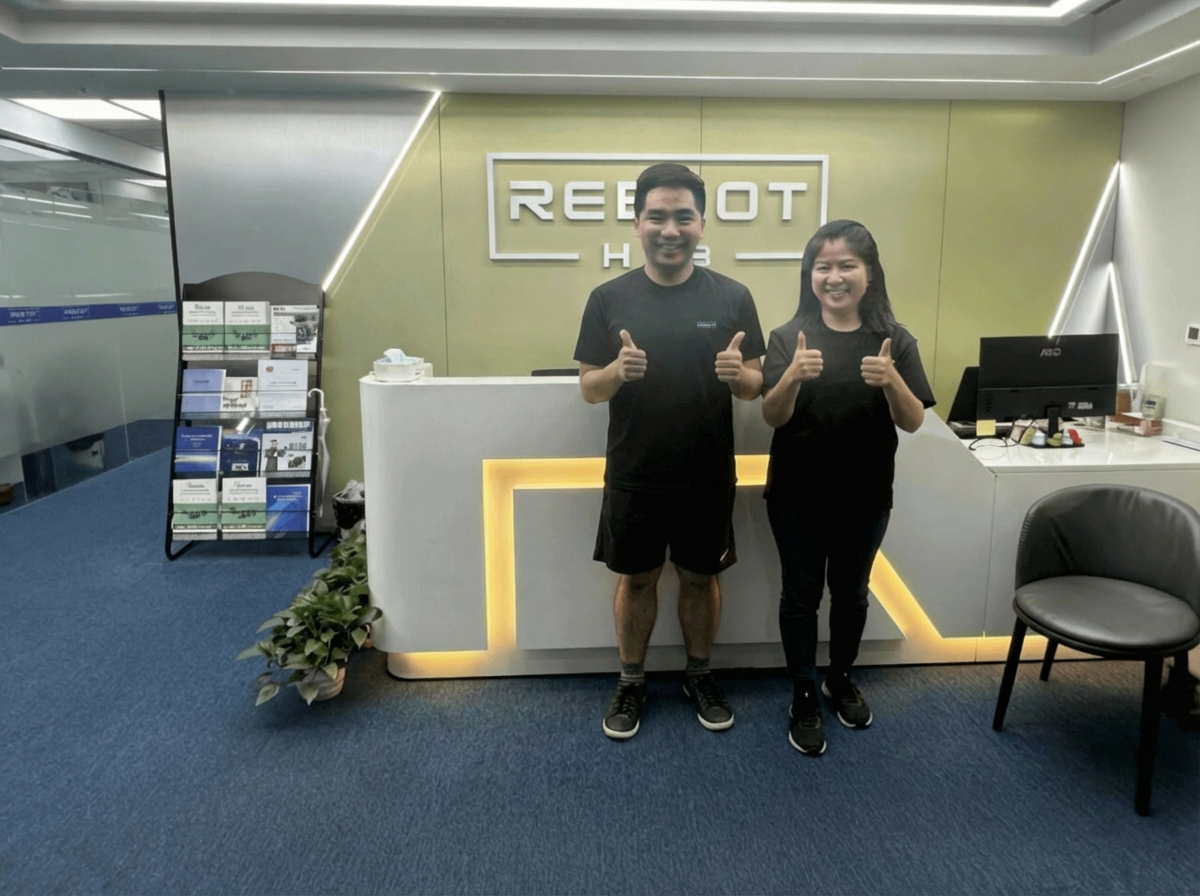
Thomas and his mother
Discover Similar Business Ideas Like Reboot Hub




More about Reboot Hub:
Who is the owner of Reboot Hub?
Thomas Lau is the founder of Reboot Hub.
When did Thomas Lau start Reboot Hub?
2025
How much money has Thomas Lau made from Reboot Hub?
Thomas Lau started the business in 2025, and currently makes an average of $33.6K/year.
More Case Studies Like This




Starter Story × HubSpot
Free tools for every part of your business.
Find customers, win deals, and automate the busywork with HubSpot's free tools.