I Make $10M/year Spotting Fake Videos Online
Who are you and what business did you start?
My name is Ivan Shkvarun, I’m a CEO and co-founder of Social Links and an author of an initiative Darkside AI. I’ve been working with data for more than 20 years. For the last few years, my team and I have been building technologies for digital investigations and open source analysis. Social Links helps businesses, security services, and government structures work with digital data, spot risks, and protect themselves from modern threats. We work with B2B and B2G segments, including corporations and national agencies. Our uniqueness is in deep expertise in OSINT and a focus on a new problem: risks that come from AI development. We are now transforming into a company that has a mission to build a trust infrastructure in the AI world. We are developing a tool, Trust Defender, that will be able to protect businesses and public institutions from AI-driven theft, deepfakes, and other digital manipulations. By the end of this year, we are aiming to reach about $10M revenue. We expect to achieve this result and secure investments to achieve our ultra-ambitious goals!
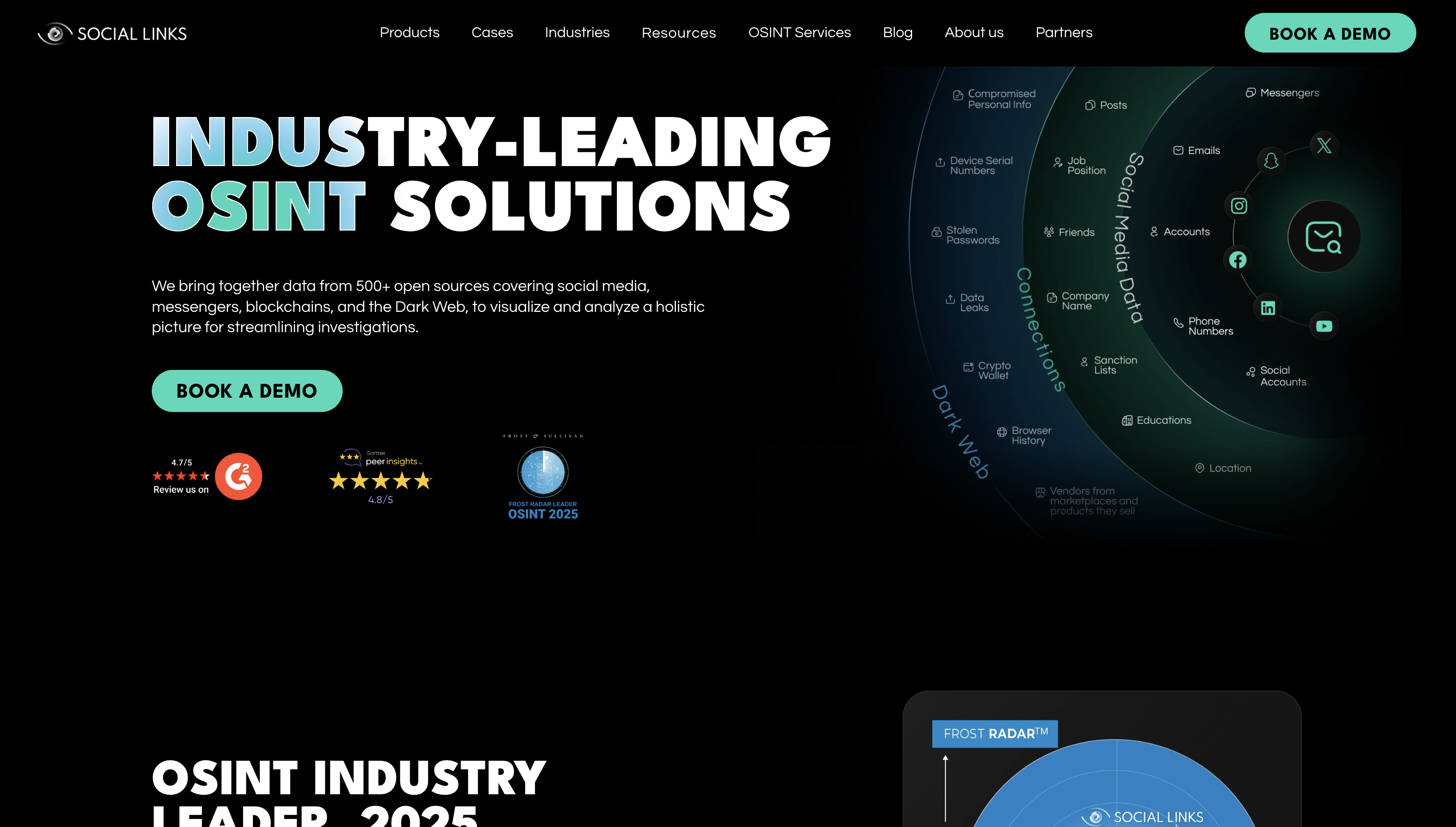
How do you come up with the idea for Social Links?
This idea didn’t appear overnight. It grew out of years of experience. I’ve been working with data since my student days, and even back then I noticed something: people try to rewrite their “digital history.” They delete information, tweak facts, cover their tracks. That taught me an important lesson: digital data can’t be trusted blindly, it has to be verified.
I remember a turning point. Not just for me personally, but for the world. In 2017, one of the first deepfakes appeared, featuring Barack Obama, the US president at that time. Then, it became clear: from that moment on, we could no longer trust what we see. Because not only text, but also visual reality itself could be fabricated. At the same time, social media was at its peak, fueling the spread of massive amounts of data, which in turn led to a surge in misinformation. All of this exposed a clear need for tools that can distinguish reality from manipulation. That’s what shaped our mission, and it hasn’t really changed since: to restore trust in data.
Social Links was founded by three people, including myself. All of us had strong technical backgrounds in IT, data risk management, and information security in the banking sector. We started working on a prototype in 2015, and within just three weeks, we had our first client. That validated the idea and proved it was viable. We realized the problem was real and people were willing to pay to solve it. I’m the only one of the three co-founders still working on the product today. Sadly, one of our partners passed away seven years ago. Another stepped away two years ago. But the company continues to grow. Today, we have over 500 clients in more than 100 countries.
We’re now actively developing a new direction in digital trust: building tools to identify and mitigate risks associated with AI. Our focus hasn’t really changed. We’re still working to help people navigate the digital world and to restore a sense of trust and reliability. We’re simply adapting to modern risks, just as we did 10 years ago when we created Social Links.
How did you build the initial version of Social Links?
Ivan Shkvarun and his team at Social Links started building their product by creating a prototype in 2015, with the first client secured within three weeks, validating the idea's viability. The team utilized their expertise in IT, data risk management, and information security to develop the product. They employed content marketing and SEO strategies to educate the market about the product and its significance, turning their blog into a key channel for distributing their content. By entering the market with small, easy-to-approve deals, they were able to grow their customer base over time through upselling and cross-selling, eventually reaching over 500 clients in more than 100 countries. Throughout the development process, they learned important lessons about market evaluation, product complexity, and the necessity of adapting to changing market dynamics.
How did you launch Social Links and get initial traction?
I had dreamed for a long time of becoming a top executive. Then I read Rich Dad Poor Dad by Robert Kiyosaki, and that’s when I realized entrepreneurship was what I truly wanted to do. In the book, he doesn’t recommend quitting everything and starting a business right away. He suggests starting small and building something of your own while you still have a job.
At the time, I was working for a company focused on SAP when we launched Social Links, initially as a side project. We saw that people simply didn’t know how to work with data.
The first and most important thing is to identify an emerging problem – something that’s just starting to become relevant, before ready-made solutions exist. By that point, I had already studied the market, traveled to the U.S., to California, and visited the headquarters of some of the smartest IT companies, like IBM and Oracle Corporation – nobody was really addressing this issue.
When we started thinking about how to launch, we decided to partner with a company that already had an existing client base and a marketplace for cybersecurity solutions. That made it much easier to get started, because their target audience matched ours.
We landed our first customer within the very first week and earned our first $100. The client told us the solution was excellent and even offered to double the payment if we could adapt it further to fit their business needs. They started using the product right away and kept telling us what was missing. That gave us the opportunity to keep improving the product based on real market demand. The fact that we received our first real market feedback within the first weeks was very motivating. Of course, the money from those first sales wasn’t enough to sustain the business. We invested our own savings into the company. Our salaries and bonuses went straight back into building it.
But we kept growing. And once we committed to it as a real business, we doubled in size every year and eventually grew to around $8 million in revenue. By the time we raised our first investment round, we already had $1.5 million in annual recurring revenue.
I think a big part of our success was the fact that we launched through a marketplace – a well-known platform in the cybersecurity industry. We were the first to offer a unique and effective solution in that space. Customers came to us from all over the world, even U.S. government agencies.
The main takeaway is simple: find a problem no one is solving, solve it, and be unique. And just as importantly, find the right path to market. For us, that was the marketplace we used to launch. Eight years later, by the way, it became our biggest competitor.
What was the growth strategy for Social Links and how did you scale?
When we launched Social Links in 2015, the world of open data was just starting to grow rapidly, largely driven by the rise of Facebook and social media in general. That was exactly the kind of data we wanted to work with.
At that point, we had zero entrepreneurial experience. I had strong management experience. I understood how to build teams and manage processes, but I didn’t know how to build a startup: how to find customers, how to scale, how to build sales. We made a lot of mistakes. But from the very beginning, we understood one thing clearly: we were building something new. There were almost no real alternatives in the market, except maybe Palantir, but they were focused on government contracts, while we wanted to build for the commercial market.
And very quickly we realized that the problem wasn’t the product, but the fact that the market simply didn’t understand what it was or why it mattered. We weren’t just selling a product, we were creating a category.
That’s how we came to content marketing. And to this day, I believe it is one of the strongest growth strategies, especially in B2B and B2G.
We started by educating the market itself: what OSINT is, how open data works, what problems it can solve. Only after that could we explain how our product fits into that.
We built our expertise around this systematically: writing articles, white papers, research, hosting webinars, and creating educational materials. Our main channel was our own blog. Deliberately, because we wanted to own our intellectual capital. Social media like LinkedIn, Facebook became distribution channels for that content, not the foundation.
At the same time, we invested heavily in SEO. If you create the best expert content in your niche, search engines start working for you.
Over the years, we built one of the largest bodies of professional OSINT content in the world. That became one of our strongest assets: the market learned the language of the industry through the language we created.
From a customer growth perspective, we had another important strategy: entering through a small initial deal.
In B2B and B2G, large contracts rarely happen immediately. So we made the entry point simple: one license, one user, one annual subscription. For customers, it was a small experimental budget: easy to approve, fast to test, without complicated procurement processes.
They would buy one license, test the product, and we would train them, show use cases, run webinars, and help them build internal knowledge. Then, over the next one, two, or three years, they would come back and expand: buy more licenses, products, and datasets.
That’s how we built a growth model based on upsell and cross-sell: start small, then grow the customer over time. And honestly, that model still works for us today.
What were the biggest lessons learned from building Social Links?
If I had to share two lessons for entrepreneurs, they would be these.
First, you don’t have to start with a huge trillion-dollar market problem. If you’re bootstrapping, it’s often better to find a smaller but deeply painful problem for a specific audience and solve it better than anyone else in the world. That’s exactly how we built Social Links. We chose a narrow problem and became the best at solving it. And that made positioning much easier. When you can honestly say, “Nobody else in the world does this,” the market starts finding you.
Second, never underestimate sales and go-to-market. A great product alone guarantees nothing. Especially now, when technology is more accessible and competition is much higher. Today, the advantage is not only in the product itself, but in distribution: who you’re selling to, how you communicate value, and what channels you use to reach them.
That’s why founders need to think about sales, marketing, and go-to-market strategy from day one.
The product is only half of the business. The other half is making sure the market knows about it and wants to buy it.
As for mistakes, we’ve made quite a few, and they were very telling.
The first one is about how we approached the market. We originally built our product as a hobby project, and as a result, we didn’t properly evaluate our target market. We chose specific user roles that we believed we could serve, and on the surface it looked like a large audience. On LinkedIn, for example, it was easy to find tens or even hundreds of thousands of people in those roles.
But what we underestimated was not the size of the market, but the accessibility of it. Even if there are hundreds of thousands or even a million potential users, it doesn’t really matter if you cannot reach them efficiently. If customer acquisition is too expensive or too complex, then the fact that the market is large doesn’t help you at all. That was one of our first real lessons: you don’t evaluate a market only by size, but by how reachable it actually is. And this is still something we’ve been working through.
The second big mistake was product complexity. Over the course of more than ten years of the company’s existence we rebuilt the product multiple times. And the core issue was that the product was largely built by engineers, without enough focus on real user experience.
We were building for very advanced professionals, and the problem with that is simple: there are not that many of them. At some point we realized that scaling would not come from adding more complexity or more features, but from simplifying the product. In the last couple of years, that has been a deliberate focus. We are not trying to make it more powerful in the traditional sense anymore; we are trying to make it more usable, more intuitive, and more accessible. Because growth comes through UX and accessibility, not through complexity.
Another important realization came from something I recently heard at a small meetup in Amsterdam from Andrey Khusid, the CEO of Miro. He said something that perfectly reflected our experience: product-market fit is temporary.
And this really resonated with us. We were among the first in the world to build a commercial OSINT product. Ten years ago, we entered what was then a very specific niche market. And over that time, we have already lost and re-found product-market fit at least twice.
There used to be this belief that once you find PMF, you can just scale it for ten years. But that no longer works. Especially now, in the age of AI, everything is changing too quickly. The reality is that every one to three years, the market shifts, and you either adapt or you effectively lose relevance.
AI made this even more obvious. On one hand, it disrupted the entire cybersecurity landscape. On the other hand, it created a completely new market. We felt this shift early and launched the Darkside AI initiative two years ago, essentially trying to understand how AI changes the nature of digital risk and crime. AIhas fundamentally rewritten the security landscape. And through this shift, we found a new niche and what is essentially our next product-market fit, which is Trust Defender.
If I try to summarize the skills that matter today for entrepreneurs, I would say there are three core ones.
The first is adaptability. The world is changing too fast to spend too much time explaining why something stopped working. You need to be able to adjust quickly, learn fast, and move on.
The second is the ability to build teams. Despite all the AI narratives and the rise of solo builders, companies are still built by teams. You don’t build anything meaningful alone. You need strong people across engineering, marketing, sales, operations, finance. And the real skill is not just hiring them, but leading them.
Which brings me to the third point: leadership. Not management. Leadership. It’s about direction, energy, and the ability to bring people together around a vision.
One of the most common mistakes I see in entrepreneurship is that people believe the product itself is the most important thing. So they rush into coding and building.
But in reality, the order should often be the opposite. First comes understanding the problem through interviews, research, and validation. Then comes a very rough prototype, sometimes even without code. Only after that comes real product development.
Otherwise, you risk building something very sophisticated that nobody actually needs.
Discover Similar Business Ideas Like Social Links




More about Social Links:
Who is the owner of Social Links?
Ivan Shkvarun is the founder of Social Links.
When did Ivan Shkvarun start Social Links?
2015
How much money has Ivan Shkvarun made from Social Links?
Ivan Shkvarun started the business in 2015, and currently makes an average of $8.4M/year.
More Case Studies Like This




Starter Story × HubSpot
Free tools for every part of your business.
Find customers, win deals, and automate the busywork with HubSpot's free tools.