My One-Man Agency Makes $13K/Month
Who are you and what business did you start?
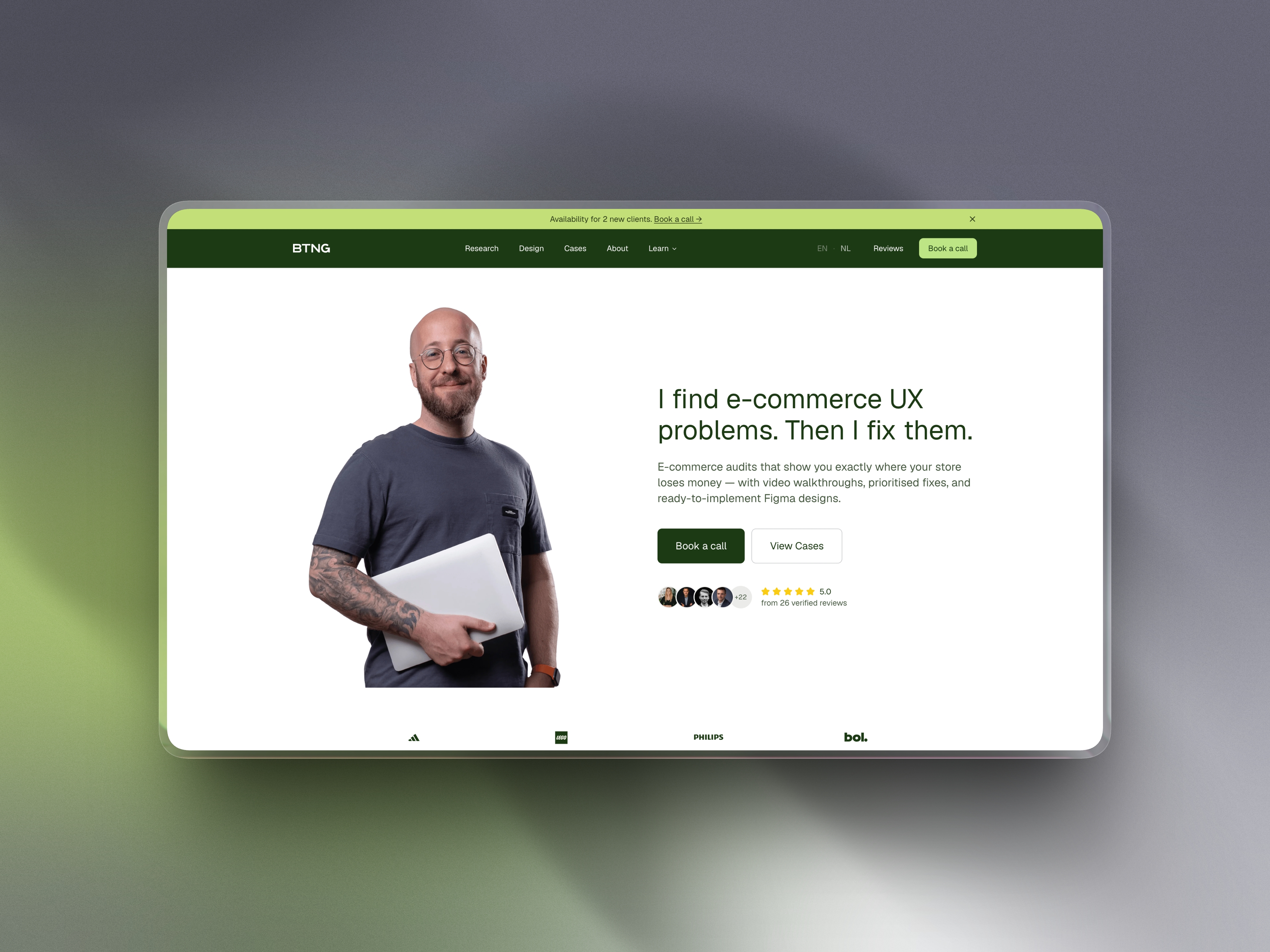
I’m Philip Wallage, a Dutch UX designer running BTNG.studio. For 20 years, I’ve worked on conversion problems for ADIDAS, KLM, LEGO, Philips. Then I went solo because I was tired of agency structure—no handoffs, no layers between the client and the work. BTNG is simple: I find the exact conversion problems on e-commerce stores and fix them. My customers are Dutch companies doing €1M–€10M annually. They have traffic and marketing. They need a senior designer but can’t justify the €60K salary. What makes me different is direct access. You get 20 years of pattern recognition, not a junior designer behind three account managers. I’ve audited hundreds of checkouts. I know where the problem is before I open your site. Revenue dropped to €140K last year after cutting poor-fit clients. This year I’m targeting €200K. The real goal is four monthly subscribers at €6,800 each—€32,400 in predictable revenue every month.
How do you come up with the idea for BTNG.studio?
I spent years as a corporate B2B web application designer. Good work, steady money, zero passion. Then I started training other freelancers on productization and niche positioning. The irony hit me: I wasn’t practicing what I preached. So I niched down to e-commerce. It wasn’t an aha moment. It was trial and error. I could design anything, but I realised I was strongest—and most interested—in conversion problems. E-commerce is measurable. You can see exactly what breaks. You can fix it and prove the impact. That’s when BTNG clicked. Not because it was the perfect idea. Because it was the right idea I was actually willing to commit to.
How did you build the initial version of BTNG.studio?
Philip Wallage built BTNG.studio by leveraging his 20 years of experience in UX design to identify conversion problems on e-commerce stores and provide solutions. He used his expertise to develop a niche positioning in the market targeting Dutch companies with an annual revenue of €1M-€10M. The development process involved creating a website that showcased his skills and offerings, which he continuously iterated on before launching. Wallage focused on direct outreach through LinkedIn, cold emails using Instantly.ai, and LinkedIn automation with Dux Soup to drive initial traction and growth for his business. Through consistent marketing efforts and delivering results, he was able to scale BTNG.studio and attract referrals from satisfied clients. Throughout the journey, the biggest lesson he learned was the importance of focusing on profitable clients and saying no to poor-fit opportunities, ultimately leading to increased revenue for the business.
How did you launch BTNG.studio and get initial traction?
Honestly, there was no big bang moment. I spent way too long perfecting the website, changing it over and over. Then at some point it just went live. That was the launch. The real work started after. I leaned on my network. LinkedIn followers, people I knew, people who’d seen my work. I reached out directly: here’s what I’m doing, here’s how I can help, want to work together? I don’t believe in the magic launch theory where customers suddenly appear. That’s not how it works. You launch the website, then you get to work. Marketing and outreach. Consistency. That’s it. My first clients came from existing relationships and direct outreach.
What was the growth strategy for BTNG.studio and how did you scale?
Growth came from three channels: LinkedIn outreach, cold email via Instantly.ai, and LinkedIn automation with Dux Soup. I post consistently on LinkedIn because that’s where my ICP hangs out. E-commerce managers, founders, heads of digital. They’re scrolling between meetings. Cold email works because it’s direct. No algorithm, no noise. Just: here’s a specific problem I solve, here’s proof I’ve solved it, let’s talk. The real growth though came from referrals and past clients recommending me. That only happens when you deliver results. My recommendation: pick one channel, commit for three months, measure it, then decide. Most people jump channels before they actually work.
What were the biggest lessons learned from building BTNG.studio?
The hardest lesson: do the thing you know you need to do but don’t want to do. I spent years designing everything. Taking every client. Building features nobody asked for. I was busy but not profitable. The breakthrough came when I stopped. I cut clients that weren’t a fit. I stopped designing outside my niche. I started saying no. That’s when revenue grew. Most freelancers make the same mistake. They think more clients mean more money. It doesn’t. Better clients at higher rates mean more money. Saying no to the wrong fit is harder than saying yes. But it’s the only way forward. Do the hard thing first.
Discover Similar Business Ideas Like BTNG.studio





More about BTNG.studio:
Who is the owner of BTNG.studio?
Philip Wallage is the founder of BTNG.studio.
When did Philip Wallage start BTNG.studio?
2024
How much money has Philip Wallage made from BTNG.studio?
Philip Wallage started the business in 2024, and currently makes an average of $162K/year.
More Case Studies Like This



Starter Story × HubSpot
Free tools for every part of your business.
Find customers, win deals, and automate the busywork with HubSpot's free tools.