How Lutra AI Went From $0 to $3.8M Seed Funding in Months

Who is Jiquan Ngiam?
Jiquan Ngiam is the co-founder and CEO of Lutra.ai, with a rich background in AI and deep learning. Originally from Singapore, Jiquan earned a PhD in Computer Science from Stanford University, working under renowned expert Andrew Ng, and has held influential roles at Google Brain and Coursera, contributing significantly to advancing AI and educational technology.
What problem does Lutra.ai solve?
Lutra.ai is solving the problem of tedious and time-consuming task automation for individuals and businesses by allowing users to automate workflows without any technical expertise, helping them save time and reduce manual errors.
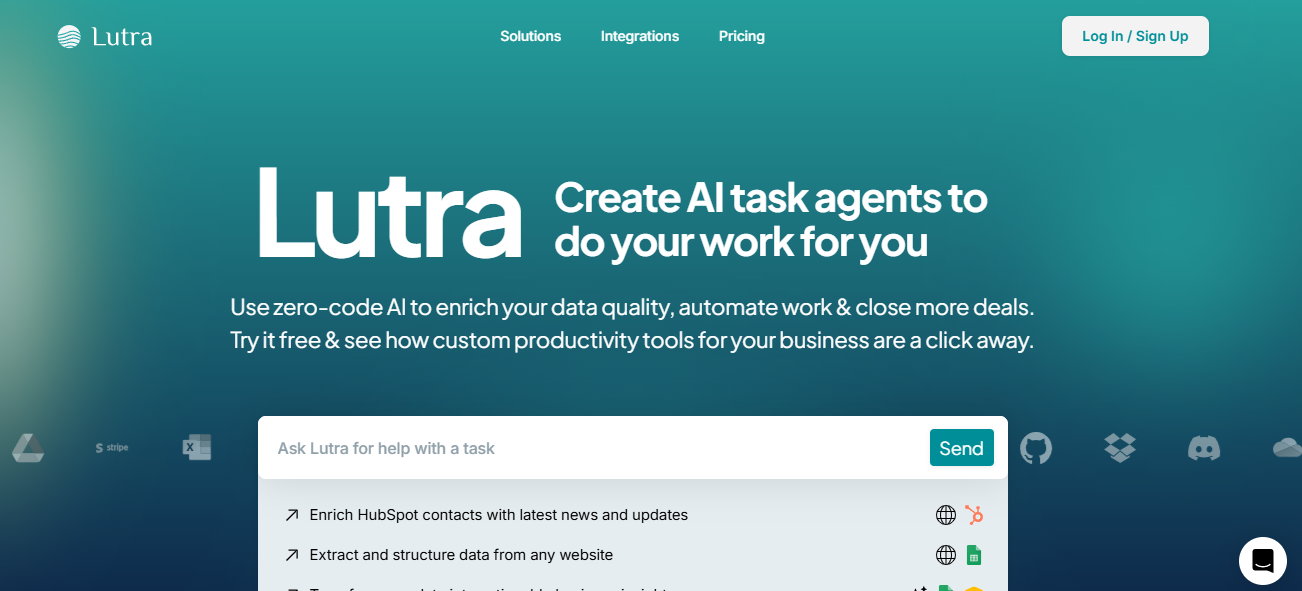
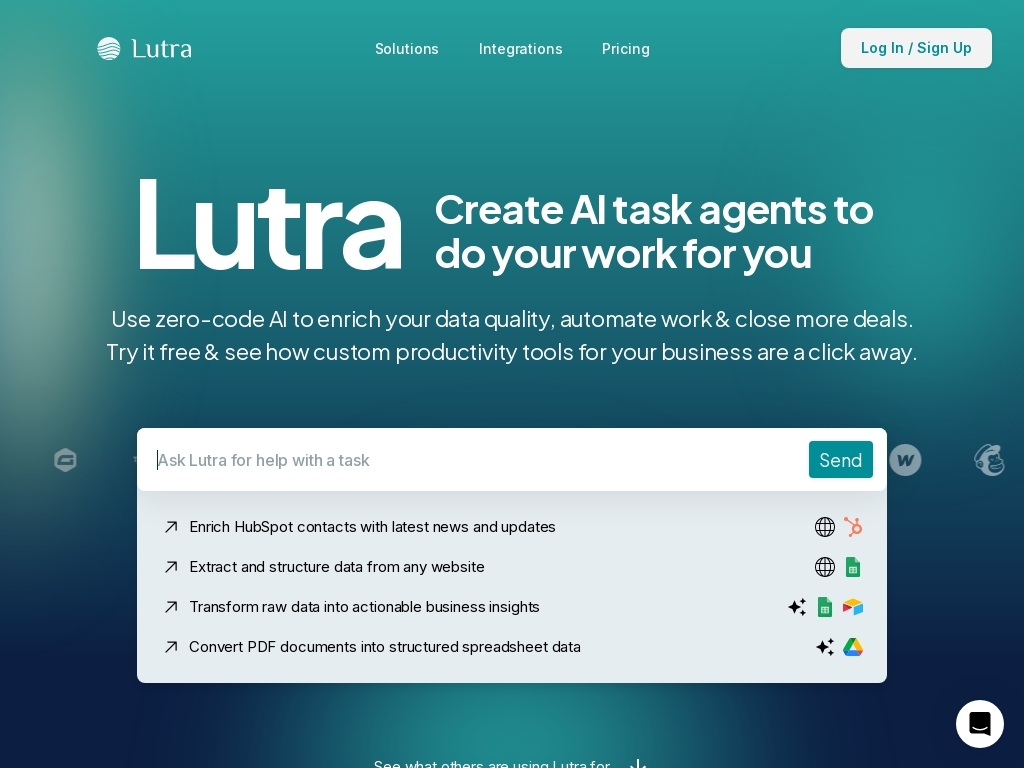
Lutra AI Homepage
How did Jiquan come up with the idea for Lutra.ai?
As Jiquan Ngiam worked at Coursera and later Google, he often recognized the potential to automate certain engineering functions to help non-developers, but he faced resource limitations. Observing these challenges, he and a group of friends, including Vijay Vasudevan, who also had experience at Google, decided to explore how AI models could be utilized for reasoning, planning, and coding in a user-friendly way. This exploration led them to consider the potential of AI not just in technical environments, but in everyday applications, imagining an AI that could connect various software services and simplify complex tasks for the average user.
They conducted various experiments to validate their ideas, focusing initially on mundane tasks like email management and internet research, demonstrating how AI could be seamlessly integrated into workflows and make them more efficient. While exploring different models, they concentrated on creating specialized assistants that offered more reliable and secure data handling, ensuring a focus on both security and usability. They faced the challenge of designing intuitive user interfaces that could engage users who may not have technical backgrounds. Despite these hurdles, the vision of making AI technology accessible to all sustained their development process.
Their approach was further shaped by continuous feedback and refinement, leading to the creation of Lutra AI. By applying AI models selectively on specific tasks, they offered a more tailored and efficient solution. Through this iterative process, they learned the importance of aligning AI capabilities with user needs, stressing that while AI can enhance productivity, the true power lies in enabling users to channel their creativity and focus on meaningful work.
How did Jiquan Ngiam build the initial version of Lutra.ai?
Building Lutra.ai involved a strategic approach to creating a user-friendly AI-driven platform capable of automating complex workflows. The development process focused on transforming natural language instructions into code, enabling seamless interaction with various apps for task automation. The Lutra team employed a code-first methodology to ensure security and reliability while executing AI workflows, using machine learning models for specific tasks to improve performance rather than relying on generic large language models for everything. It took several months to build the first version, tackling challenges such as ensuring the integration of AI with existing systems and maintaining data security. The team, comprising ex-employees from Google and Coursera, had to navigate the complexities of AI's nascent technology, constantly adapting to changes in the AI landscape to refine and stabilize the product.
What were the initial startup costs for Lutra.ai?
- Funding: Lutra AI recently raised $3.8 million in seed funding from investors such as Coatue Ventures, Hustle Fund, Maven Ventures, and WVV Capital, along with a group of angel investors including Andrej Karpathy, Jeff Dean, and Scott Belsky.
How did Jiquan launch Lutra.ai and get initial traction?
Lutra.ai launched a product with real users executing enterprise workflows, gradually onboarding more customers. They began showcasing their new user experiences at industry events like Imagine AI Live and rolling out the platform publicly to expand user adoption.
What was the growth strategy for Lutra.ai and how did they scale?
Product-Led Growth Approach
Lutra.ai's primary growth channel is a product-led growth strategy. They focus on making their platform incredibly user-friendly and impactful from the moment a user engages with it. This approach ensures that users can quickly see the value, often within minutes, without needing technical expertise. The simplicity and efficiency of the product encourage users to adopt it independently, thus driving organic growth and adoption.
Why it worked: By emphasizing ease of use and immediate utility, Lutra attracts users who are looking for quick solutions to complex problems. The product’s capacity to deliver instant value without a steep learning curve makes it appealing to both individuals and enterprises, helping to create a natural pull effect without extensive marketing spend.
SEO and Content Strategy
Lutra leverages educational content to engage potential users, focusing on the intersection of AI and workflow automation. This involves publishing in-depth articles and podcasts that explain their technology and showcase its efficiency in automating business tasks.
Why it worked: Educational content helps position Lutra as an authority in AI-driven workflow automation while driving traffic through organic search. By creating content that solves user queries and showcases how Lutra can integrate smoothly into existing workflows, they increase brand awareness and attract potential customers actively seeking automation solutions.
Integration with Popular Platforms
Lutra.ai integrates with popular platforms such as HubSpot, Google Workspaces, and Slack. By doing so, they tap into the existing user bases of these applications, enabling seamless automation of tasks like email management and data processing.
Why it worked: By connecting with widely-used platforms, Lutra reduces the friction that potential users face when trying to integrate a new tool into their existing operations. This interoperability makes their solution more attractive, as it fits naturally within the digital ecosystems their customers already use, thus enhancing user acquisition and retention.
Partnerships and Networking
Lutra has engaged in strategic partnerships and networking with firms like Coatue Ventures and other angel investors to bolster credibility and enhance visibility. These collaborations support both the product development and market entry stages, helping to expand their reach and improve the platform based on feedback from connected industries.
Why it worked: Collaborating with reputable partners and investors not only provides financial backing but also opens doors to industry networks that can facilitate introductions to potential clients and advocates. This social proof helps build trust in Lutra’s offerings, encouraging adoption among businesses looking to leverage AI for workflow automation.
What's the pricing strategy for Lutra.ai?
Lutra.ai offers a subscription model starting at $15/month, scaling up based on API usage and team size, providing additional enterprise plans for businesses requiring custom integrations and enhanced support, emphasizing a secure, code-first approach to AI automation.
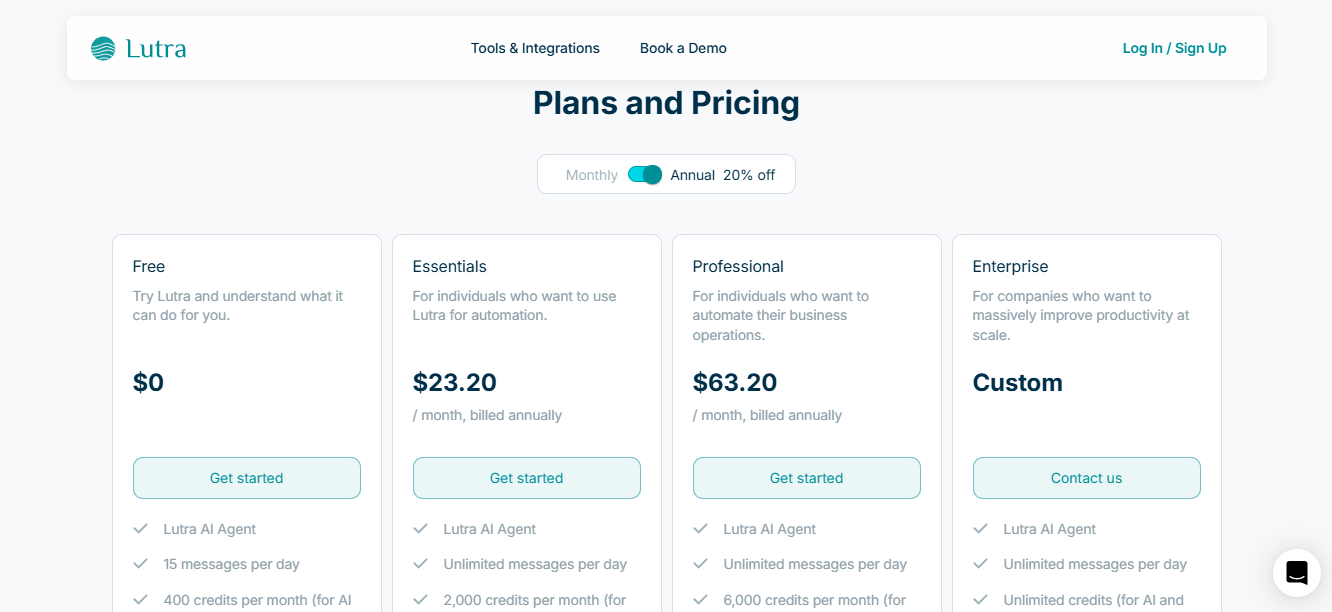
Lutra AI Pricing
What were the biggest lessons learned from building Lutra.ai?
- Simplify Complex Tasks with AI: Lutra.ai can automate sophisticated workflows, like data enrichment and processing, by efficiently interconnecting various applications. This simplifies complex and repetitive tasks, freeing up time for more strategic work.
- Prioritize User-Friendliness: Lutra emphasizes creating an intuitive user interface that allows non-technical users to utilize AI through natural language prompts. Ensuring accessibility broadens the potential user base and encourages adoption.
- Adapt AI Intelligently: By focusing large language models on specific tasks and integrating them securely into existing systems, Lutra provides more reliable and effective solutions, showing the importance of strategic AI application in providing robust business tools.
- Embrace AI for Enhanced Productivity: Lutra exemplifies how AI can boost productivity by automating routine parts of workflows, such as data categorization and updates, allowing businesses to scale tasks and focus on creativity and decision-making.
- Stay Resilient Amid Rapid Change: The AI landscape is rapidly evolving, and Lutra demonstrates the importance of staying adaptable. Building flexible and scalable AI solutions prepares businesses to leverage breakthroughs without needing to constantly overhaul systems.
What platform/tools does Lutra.ai use?
Lutra.ai Acquisition: How much did Lutra.ai sell for and what was the acquisition price?
Lutra AI was acquired for $3.8 million in December 2023, with seed funding from Coatue Ventures and notable angel investors including Andrej Karpathy and Jeff Dean.
Discover Similar Business Ideas Like Lutra.ai







More about Lutra.ai:
Who is the owner of Lutra.ai?
Jiquan Ngiam is the founder of Lutra.ai.
When did Jiquan Ngiam start Lutra.ai?
2023
What is Jiquan Ngiam's net worth?
Jiquan Ngiam's business makes an average of $417K/month.
How much money has Jiquan Ngiam made from Lutra.ai?
Jiquan Ngiam started the business in 2023, and currently makes an average of $5M/year.