My Meal-Planning App Makes $1,700/Month Helping Busy Parents
Who are you and what business did you start?
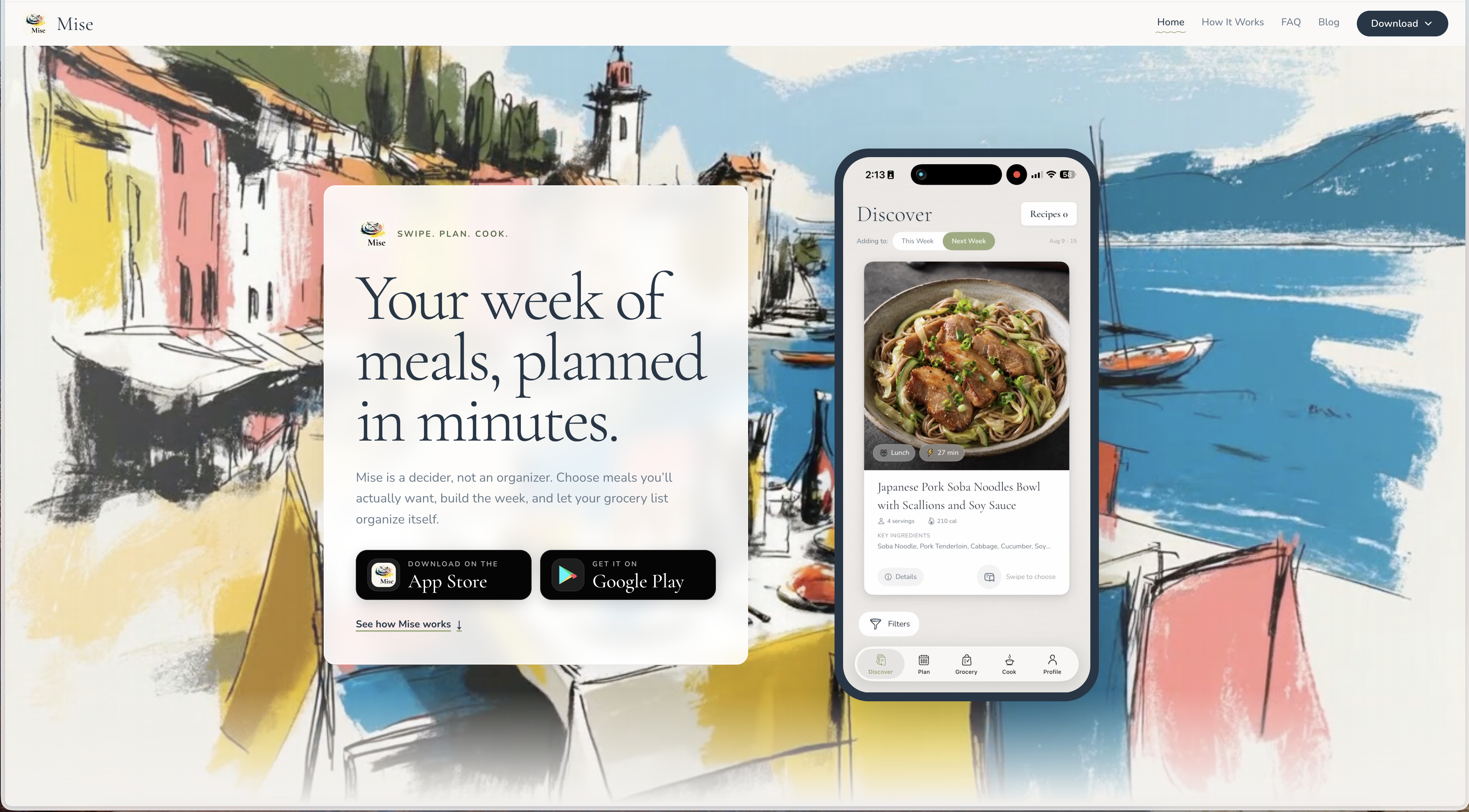
I'm Alex Fromm, a product designer, busy dad of two, CEO and one of three co-founders of Mise, alongside Bryce Henley and David Fantham. As busy parents and professionals ourselves, we built Mise for people like us: families, working parents, and professionals who want the relief of knowing what’s for dinner without adding another planning job to an already full week. Mise is a calm, practical meal-planning app for iPhone and Android. It helps customers move through one connected flow—discover recipes they actually want, plan the week in minutes, shop from an organized grocery list, and cook with confidence from clear steps. Mise began as a bootstrapped side project and now generates about $1,700 in monthly subscription revenue. We’re not just organizing recipes; we’re helping people make the dinner decision once, then get on with their week. Swipe. Plan. Cook.
How do you come up with the idea for Mise?
The idea started almost 10 years back. I've been designing software for 14 years, but mostly in the B2B space and at enterprise scale. But every so often the same idea would pop in my head; what if I merged Tinder and Recipes to make finding and plann ing my meals easier and more fun? Over the years I would always come back to the idea, but never really took the time to learn how to code. Between work, life with my wife, and eventually kids, I just didn't really get the deep spark to solve the problem.
But the idea never went away. Year after year I would always come back to this idea. "If only meal planning and recipe discovery could be easier!" Then my wife and I had kids and life's difficulty shot up a few levels. But the need was still there, and now I had 2 more mouths to feed! I tried other apps but non of them really worked the way I wanted. They always fell short in some part of the full process of finding meals, making a meal plan, getting the shopping done, and then finally cooking. But still I was blocked by my time. That was, until, AI became good enough to build.
Most of the last few years I have been playing with AI. Working at Microsoft we are surrounded by it constantly and so I began dabbling in how to use it at work. My first use was to capture raw ideas with Voice to Text and began building a backlog of business ideas. Things I was interested in or where I felt software and a deep understanding of the problem space would net something people actually would use. My first project was building www.whenworks.cc to solve my own need of coordinating my buddies golf trip. Using Claude and ChatGPT to build that proved that I could make something and get people using it. So i went back to my list of projects I had been building over the year and the meal planning problem reared it's head again. I was hesitant to build a full iOS app, but was really excited at the challenge and began spending almost every night after kiddo bed time working on the idea. Over a few days i went from a simple web prototype to test out the swipe interaction to using my 2016 MacBook Pro to start building on iOS.
It was incredibly slow at first, mostly because the MacBook, but in a few short days I had the first moment of "man this might actually work". I had a app running on my phone where i could swipe through recipes - and it felt pretty damn awesome. From there I followed my intuition and looked at the full experience I had when trying to plan my weeks of meals. I refined and iterated daily, tightening up the workflow from discover, to plan, to grocery list, to cook, and ended up in a spot where i could share it with my friends and family. That first round of feedback was when I doubled down - people loved the swipe and felt like they'd actually use it weekly. So i upgraded my MacBook and kept cranking away. Using a ton of different AI Tools i created the brand, the imagery, the design system, and polished the app. I used Claude and ChatGPT to build out the backend. I refined and refined until I had something I was proud of.
During this process I kept validating with friends. I brough on two of my best friends to join, Bryce and David, to help with marketing and product. Through all of it I kept my eye on what I wanted this to do and follow my passion and intuition. Then we launched in July and saw a huge spike of discovery and usage. Now we are focusing on marketing, growth, and continued improvement of the app.
How did you launch Mise and get initial traction?
Our launch started with a clear goal that is simple and sustainable: build something, launch it into the world, and make $1. The first conversion happened in the first day! We had a huge spike of users and a large portion converted in the first week and by the end of month 1 we had a MRR of over $1000. As of this writing we are at $1954 and have made $3993 in total revenue. That entire first month we were blown away by the reaction and response. I often sent screen shots of RevenueCat to Bryce and David to show the latest sales and numbers - truthfully we couldn't believe it and were floating on cloud 9.
When it came to telling the world about our business, thankfully Bryce is a very experienced marketer. We focused on LinkedIn leading up to our July 8th launch telling our story and building some excitement. Then we worked across TikTok, X, and Instagram to try and amplify. Our launch went better than we expected, garnering thousands of downloads and surprising all of us. We also posted on Product Hunt and a few other similar sites where we got some of our first real bits of feedback from new customers. Overwhelmingly the swipe experience made planning and discovery feel easy. The biggest launch learning for me was just how much coordination and thinking goes into. As a product focused person I know I could not have launched this as well without Bryce on our team.
But the launch didn't go completely according to plan. While the iOS app was our main driver, I also wanted to get Android out at the same time to make sure we could support more customers in their meal planning journey. I worked day and night leading up to our launch to get the android version built, leaning heavily into Codex to translate our iOS app into an Android equivalent. It was definitely a tight time crunch, but the effort paid off as we launched both the same day. Unfortunately, that speed lead to some potentially dire mistakes. Specifically, when creating our Annual subscription, i went too fast and accidentally made our annual plan charge monthly. This went for 2 weeks before i noticed the discrepancy and went into full damage control mode! Thankfully we never double charged our customers and reached out to each of them personally to let them know about the accident, rectify their subscription, and offered them extra time on their current year subscription. It taught me that speed is great, but for release make sure you take your time to review the important stuff! Thankfully we didn't break any customer trust, but it could have been way worse.
What was the growth strategy for Mise and how did you scale?
What tactics or strategies have you used to get more customers?
We launched Mise in July and we're still early. Growth so far has come from a few repeatable things running in parallel, not one breakout channel.
On the foundational side, we've done the boring, necessary SEO work: optimizing the App Store and Google Play listings with the right keywords, making sure the website pages are structured and indexed correctly, and building out content that answers the searches people actually do when they're frustrated with meal planning. Nothing glamorous, but it compounds.
Alongside that, I write on LinkedIn as a founder. Product updates, honest reflections on building a bootstrapped app, lessons learned. I share what's actually happening, not a polished version of it. That's driven awareness and a handful of direct downloads from people who find the story relatable.
We also create short-form video for TikTok, Instagram, and Facebook, because Mise is a product people need to see to understand. Reading about a swipe-based meal planner doesn't have the same impact as watching someone swipe through recipes, build a week's plan, and get a grocery list in two minutes. So we prioritize visual content that shows the full flow.
What channels have you used to grow your business? Why did you use this channel?
App Store, Google Play, LinkedIn, TikTok, Instagram, and Facebook.
We chose social video because the product really clicks when you watch it. We chose LinkedIn because I'm a founder with a day job at Microsoft who built this on nights and weekends, and that story connects with a specific audience of people who are thinking about doing the same thing. We use the app stores because that's where the purchase happens, and your store page is often the last thing someone reads before they decide.
Share a real example of a strategy or tactic you used to grow your customer base.
One thing that's worked is taking one specific customer truth and building several pieces of content from it instead of starting from scratch every time.
The insight we kept coming back to: 400 saved recipes still do not become Tuesday dinner. That frustration is the whole reason Mise exists. So instead of inventing new campaign angles, we adapted that single idea across formats. A LinkedIn post from our perspectives as founders. A screen recording that shows the problem and the solution without any narration. A short video that follows someone through the whole flow from "what are we eating this week?" to a complete grocery list.
Each piece is native to where it lives. But they're all anchored to the same moment every meal planner recognizes.
Why did this strategy or tactic work? What can readers learn from your experience?
We're a team of three bootstrapped founders. Nobody has 20 hours a week to produce original content. If we had to invent a new angle every time, we'd post twice and stop.
Finding one true, painful moment and proving your product solves it is both a marketing strategy and a product clarity exercise. If you can't describe the moment in one sentence, you probably don't understand your customer well enough yet. When we landed on "400 saved recipes still don't become Tuesday dinner," it sharpened how we thought about the product, not just how we talked about it.
The repeatable format also means we can keep showing up without burning out.
Do you have any recommendations for aspiring entrepreneurs trying to grow their business?
A few things I'd actually tell someone starting out:
Do the boring SEO work first. Optimize your store listings. Make sure your website is findable. This is slow and unsexy and it matters.
Pick one real customer moment your product solves. Not a feature, a moment. The specific frustration that makes someone pull out their phone.
Show the product working, not just describe it. Especially if you're building something with a flow or a sequence.
Measure activation before you scale promotion. We care more about whether someone completes their first meal plan than how many people downloaded the app. Reach is encouraging. Retention is the evidence.
And be honest about where you are. We're still figuring this out. That honesty builds more trust than pretending you've cracked it.
What were the biggest lessons learned from building Mise?
Now is probably the best time in history to build something. I've worked in tech for 14 years, and I've never felt this kind of possibility. AI means the gap between an idea in your head and something real in the world is smaller than it's ever been. This is true not just for engineers, but for anyone. If you have a problem you want to solve, you can start solving it.
That said, the biggest mistake I see people make is treating AI like a shortcut around understanding. It isn't. It's a multiplier on what you already know. When I started building Mise, I leaned hard on 14 years of product and design experience. That background shaped every decision: how the flows should work, what the interactions should feel like, what to build first. AI could execute a lot of that faster than I could on my own, but it couldn't replace the judgment. The people who will get the most out of these tools are the ones who take the time to understand the underlying fundamentals, even imperfectly. Build and learn at the same time. Don't skip the learning.
The other thing I'd tell anyone starting out: stay obsessed with the problem. There's a lot of energy right now around building in public, chasing customers, moving fast. All of that is fine. But if you lose sight of the actual problem you're solving, none of the rest of it holds together. With Mise, I kept coming back to one question: how do you help someone go from "I want to cook more" to actually having a plan for the week, without it feeling like a second job? That question stayed at the center of every decision. Find your version of that question and don't let go of it.
And then: show up. Most evenings after work, I opened my laptop and moved something forward, even if it was just 10%. That's it. I started building on a 2016 Intel MacBook Pro that took 10 to 15 minutes just to compile the app. Not ideal. But the machine wasn't the constraint. Showing up was. Over eight months, 10% nights add up to a product.
You don't need the perfect setup. You don't need to already know everything. You need a real problem, a willingness to learn, and the discipline to keep going on the nights it feels slow.
Discover Similar Business Ideas Like Mise




More about Mise:
Who is the owner of Mise?
Alex Fromm is the founder of Mise.
When did Alex Fromm start Mise?
2025
How much money has Alex Fromm made from Mise?
Alex Fromm started the business in 2025, and currently makes an average of $20.4K/year.
More Case Studies Like This




Starter Story × HubSpot
Free tools for every part of your business.
Find customers, win deals, and automate the busywork with HubSpot's free tools.