I Make $40K/Month Selling Business Reports
Who are you and what business did you start?
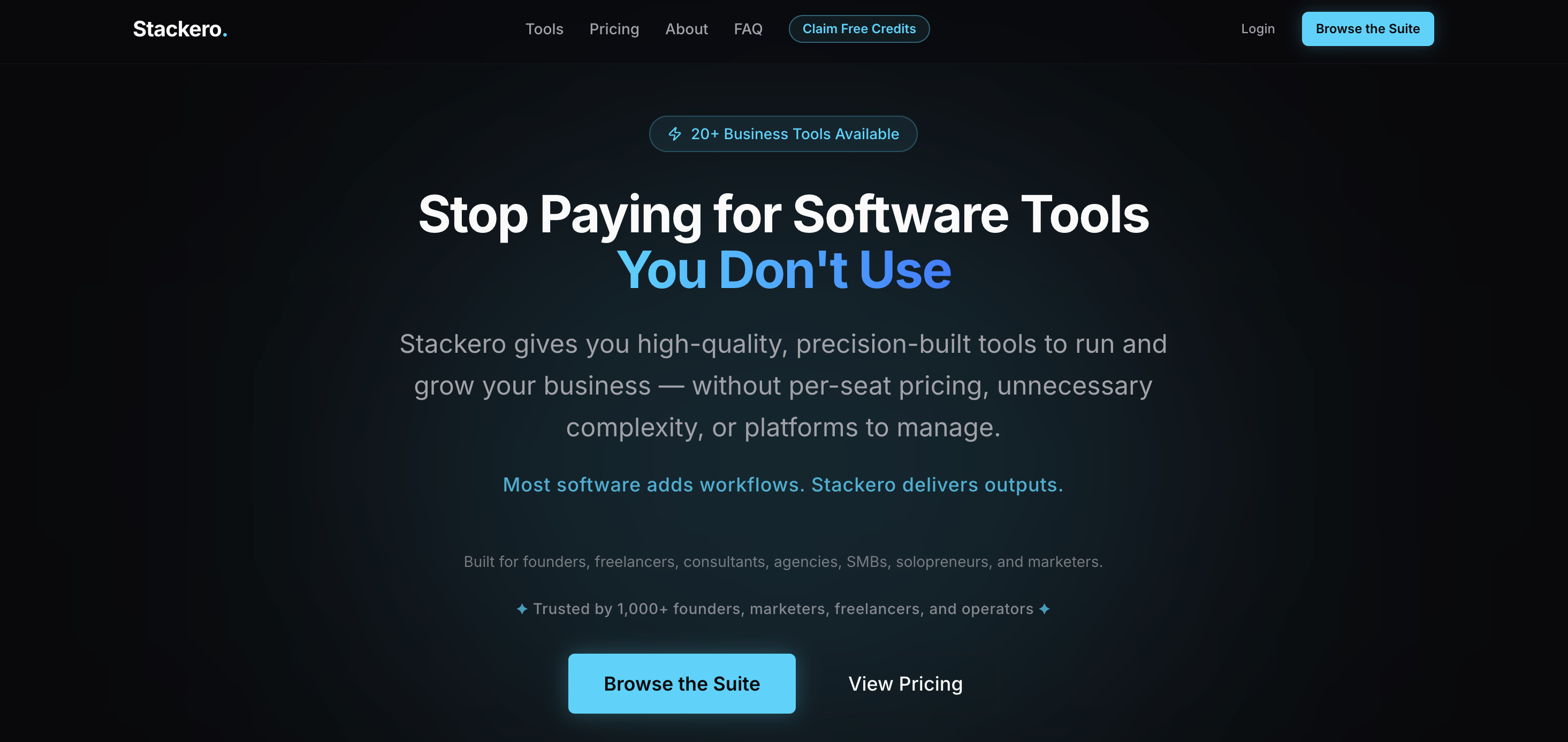
I’m Crosby O’Connor, founder of Stackero. I’ve spent nearly 20 years in growth, marketing, strategy, and customer acquisition, and I kept seeing the same thing: smart people were paying for more expensive software but still struggling to answer, “What should I actually do next?”
Stackero is a suite of premium business tools for founders, freelancers, consultants, agencies, marketers, operators, solopreneurs, and SMBs. Instead of another bloated dashboard, that takes hours to decipher, Stackero creates useful business outputs like audits, plans, pricing recommendations, positioning reports, growth analysis, CRM leak reports, and AI search visibility insights. Stackero cuts out the middle part and goes straight to the outputs our ICP needs to make qualified decisions. What makes it different is that it is built around the output, not the workflow. I launched publicly in early 2026 and have seen revenue grow consistently the past 5 months to approximately $40k/mo, while looking on how Stackero can continue to grow month-over-month

My image
How do you come up with the idea for stackero.co?
I came up with Stackero after years of helping clients and teams work through the same business questions: how to price an offer, fix positioning, improve conversion, build a growth plan, audit a funnel, or figure out why leads were not turning into revenue. The software market kept getting bigger, but the core problem stayed the same. People had tools, but not enough clarity.
I knew Stackero was the right idea because it came from problems I had seen firsthand, not a trend I was chasing. The “aha” moment was realizing most people do not want another platform to manage. They want the ability to make decisions from the data they have, quickly and efficiently.
That made Stackero different from other ideas I had explored. In the past, I sometimes tried to go too big, too complex, or build too many features before proving the core value. With Stackero, I forced myself to keep it simple: build focused tools that solve real business problems and deliver useful outputs quickly.
My background is directly tied to the business. I’ve worked in growth, marketing, demand generation, strategy, digital acquisition, and business development across startups, agencies, SMBs, enterprise teams, and global brands. I validated Stackero by testing tools with 1000+ real users, collecting feedback, improving the outputs, and watching whether people immediately understood the value, and would pay for it. When users could see how much time and guesswork the tools saved, I knew there was something worth launching.
How did you build the initial version of stackero.co?
To build Stackero, founder Crosby O'Connor focused on creating useful business outputs, such as audits, plans, pricing recommendations, positioning reports, growth analysis, CRM leak reports, and AI search visibility insights. They used their experience in growth, marketing, and customer acquisition to validate the idea by testing tools with 1000+ real users and collecting feedback to improve outputs. The first version of Stackero was launched publicly in early 2026, and it took about one day to make the first sales. O'Connor learned the importance of simplicity, clarity, and founder-led outreach in building a product that solves real business problems and delivers value quickly.
How did you launch stackero.co and get initial traction?
I told the world Stackero was live the same way I built it: directly, honestly, and without trying to sound like another tech startup chasing hype. I launched first on LinkedIn through DMs, and the Stackero company page, then reached out to friends, former colleagues, clients, and people in my network who understood the problem. I also did a tiered referral program to help compound efforts. The message was simple: most people do not need another bloated software platform. They need useful business outputs that save time, reduce guesswork, and help them make sharper decisions.
The tactics were intentionally scrappy. I the story of Stackero, invited people to try it, sent direct messages to people who fit the audience, shared it with friends and family, and started showing people what the tools actually produce instead of just talking about features. My focus was not on a giant launch campaign. It was on getting the right people to understand the value quickly.
The response was encouraging. We had 1000+ people try Stackero the first month, and people immediately understood the pain point. A lot of the feedback was some version of, “This makes sense,” “I can see how this would save a lot of time,” or “This is the kind of tool I wish I had when trying to figure out what to do next.”
The biggest lesson from launch was that clarity matters more than volume. People do not buy just because you say something is live. They buy when they understand the problem you solve, see themselves in the use case, and believe the output will help them move faster.
We made our first sales the night after launch, which was a huge moment. It was not a viral explosion or some overnight fantasy. It was better than that: real people saw the product, understood the value, and paid for it. That first dollar mattered because it confirmed that Stackero was not just interesting. It was useful enough for someone to pull out a credit card.
The first few customers came from founder-led outreach, LinkedIn, warm conversations, and showing the actual tools and outputs. I think that is the right way to start. Before trying to scale with ads or automation, I wanted to earn trust manually, learn from real users, and make sure the product keeps getting better.
It took about one day from public launch to make our first sales. The biggest thing I learned is that I am much more motivated when I am building something practical for people who need help now, not just chasing a startup idea because it sounds exciting. Stackero feels different because it is rooted in problems I have seen firsthand for years.
What was the growth strategy for stackero.co and how did you scale?
Since we began testing Stackero in January, growth has been very intentional and founder-led. I knew this was not the type of product people would fully understand from one generic launch post or ad. They needed to see the tools, understand the use cases, and connect Stackero to a problem they were already trying to solve.
The first strategy was direct outreach. Instead of sending the same message to everyone, I started matching people to the specific tool that fit their situation. If someone was struggling with pricing, I sent them a short video walkthrough of a pricing or offer tool. If someone was trying to improve a landing page, I showed them the grader. If someone was thinking about freelancing or consulting, I pointed them toward tools for ICP, positioning, offers, and planning. That worked because it felt useful, not like a pitch.
I also used email to follow up with people who had tried tools, requested credits, or showed interest. The emails were simple and practical: here is what Stackero does, here is where to start, and here is the tool I would recommend based on what you are working on.
Another key driver has been our referral program. Stackero is built for people who know other people trying to grow businesses, start freelance work, run agencies, consult, market, sell, or build something of their own. Referrals work well because the product is easier to trust when it comes from someone who has already seen the output and understands the value.
One of the more personal growth strategies has been offering free credits to people affected by layoffs, job instability, or the broken hiring market who are trying to start freelance, consulting, fractional, creator, or small business work. That program is not just a marketing tactic. It reflects why I built Stackero in the first place: to lower the barrier for people who need practical tools, clearer strategy, and a faster way to get moving without another expensive platform in their way.
I also started testing communities like Reddit, Slack groups, and founder/operator spaces. The approach there is not to drop links and disappear. It is to answer real questions, share useful frameworks, and mention Stackero only when it genuinely fits the problem. If someone asks about pricing, positioning, landing pages, sales plans, or growth, that is a natural opening to say, “Here is how I would think about it, and here is a tool that can help.”
The biggest lesson is that specific beats broad. “Check out my startup” is weak. “You mentioned your offer is not converting, here is a tool that can help you diagnose why” is much stronger.
My advice to aspiring entrepreneurs is to stop thinking of growth as one big channel and start thinking of it as a series of trust-building moments. Show people the product. Send personalized examples. Make it obvious where they should start. And before you spend heavily on ads, prove that real people understand the value enough to use it, share it, and pay for it.
What were the biggest lessons learned from building stackero.co?
The hardest part of building Stackero was not the idea. It was staying disciplined enough to keep it simple.
In the past, I made the mistake a lot of founders make: I tried to go too big too early. I wanted to build the complete platform, the perfect workflow, the huge product vision, the thing that could eventually do everything. That sounds exciting, but it can also become a trap. Complexity feels like progress until you realize you have built something people have to work too hard to understand.
With Stackero, I had to keep coming back to one question: what is the useful output?
Not the feature. Not the dashboard. Not the shiny AI layer. The output.
That changed everything.
There were plenty of hard moments. Some tools were not good enough at first. Some outputs felt too generic. Some flows needed to be rebuilt. Some ideas sounded great in my head but did not actually make the product better. I had to learn to cut things, simplify things, and stop protecting ideas just because I liked them.
I also had to learn how to launch before it felt perfect. That is hard for me. My instinct is to polish, test, refine, and keep improving. That can be a strength, but it can also delay the moment where real users teach you what actually matters.
One good decision was making Stackero founder-led from the beginning. I did not want to hide behind ads or generic launch copy. I wanted to talk to people, show them the tools, send personalized walkthroughs, ask what they were trying to solve, and point them to the right place to start. That made the launch feel more human, and it helped me learn faster.
Another good decision was building a referral program and offering free credits to people affected by layoffs, job instability, or the broken hiring market who are trying to start freelance, consulting, fractional, creator, or small business work. That was not just a growth tactic. It was a reminder of why Stackero exists: to help people move forward without another expensive barrier in the way.
There were also forces outside my control that helped. The timing matters. People are tired of paying for software they barely use. They are overwhelmed by AI hype. They are hearing nonstop advice about building agents, automating everything, and stacking more tools, when a lot of them just want to run their business, find clients, price better, improve conversion, and make smarter decisions without breaking the bank.
That trend created the opening. Stackero works because it does not ask people to become technical operators of some complex system. It gives them the report, audit, plan, recommendation, or next step they needed in the first place.
The biggest lesson I learned is that simple is not the same as small. Simple can be powerful. Simple can be premium. Simple can save people hours.
I also learned that clarity is a growth strategy. If people do not understand what you do, they will not buy. If they understand the exact problem you solve and can see themselves using it, everything changes.
The skills that helped me most were not technical. They were pattern recognition, marketing judgment, customer empathy, positioning, and the ability to turn messy business problems into clear next steps. Nearly 20 years in growth and marketing helped me see which problems were real, which outputs were valuable, and where people were wasting time.
My top advice to other entrepreneurs is this:
Do not build the biggest version of your idea first. Build the clearest version.
Do not chase every feature. Find the painful problem, solve it in a way people understand quickly, and get it in front of real users as soon as you can.
Do not confuse attention with traction. A launch post is not a business. Traffic is not a business. Real traction starts when people use it, pay for it, come back, tell someone else, or say, “I needed this.”
The mistake I see a lot of founders make is trying to sound impressive instead of useful. They describe the technology, the platform, the AI, the automation, the future vision. But most customers are asking a much simpler question:
“Can this help me right now?” If the answer is yes, make that obvious.
Starting a business is a strange mix of confidence and humility. You need enough confidence to keep going when nobody is paying attention yet. You need enough humility to admit when something is confusing, broken, too complicated, or not valuable enough.
Stackero has already taught me that the best businesses are not always born from chasing the biggest trend(s). Sometimes they come from paying close attention to the same problem over and over until you finally decide to solve it.
That is what Stackero is for me. It is the result of years of seeing people need better answers, clearer strategy, and more practical tools.
And I believe it is just getting started.
Discover Similar Business Ideas Like stackero.co




More about stackero.co:
Who is the owner of stackero.co?
Crosby O'Connor is the founder of stackero.co.
When did Crosby O'Connor start stackero.co?
2026
How much money has Crosby O'Connor made from stackero.co?
Crosby O'Connor started the business in 2026, and currently makes an average of $504K/year.
More Case Studies Like This




Starter Story × HubSpot
Free tools for every part of your business.
Find customers, win deals, and automate the busywork with HubSpot's free tools.