My AI Detection App Makes $21K/Month
Who are you and what business did you start?
My image
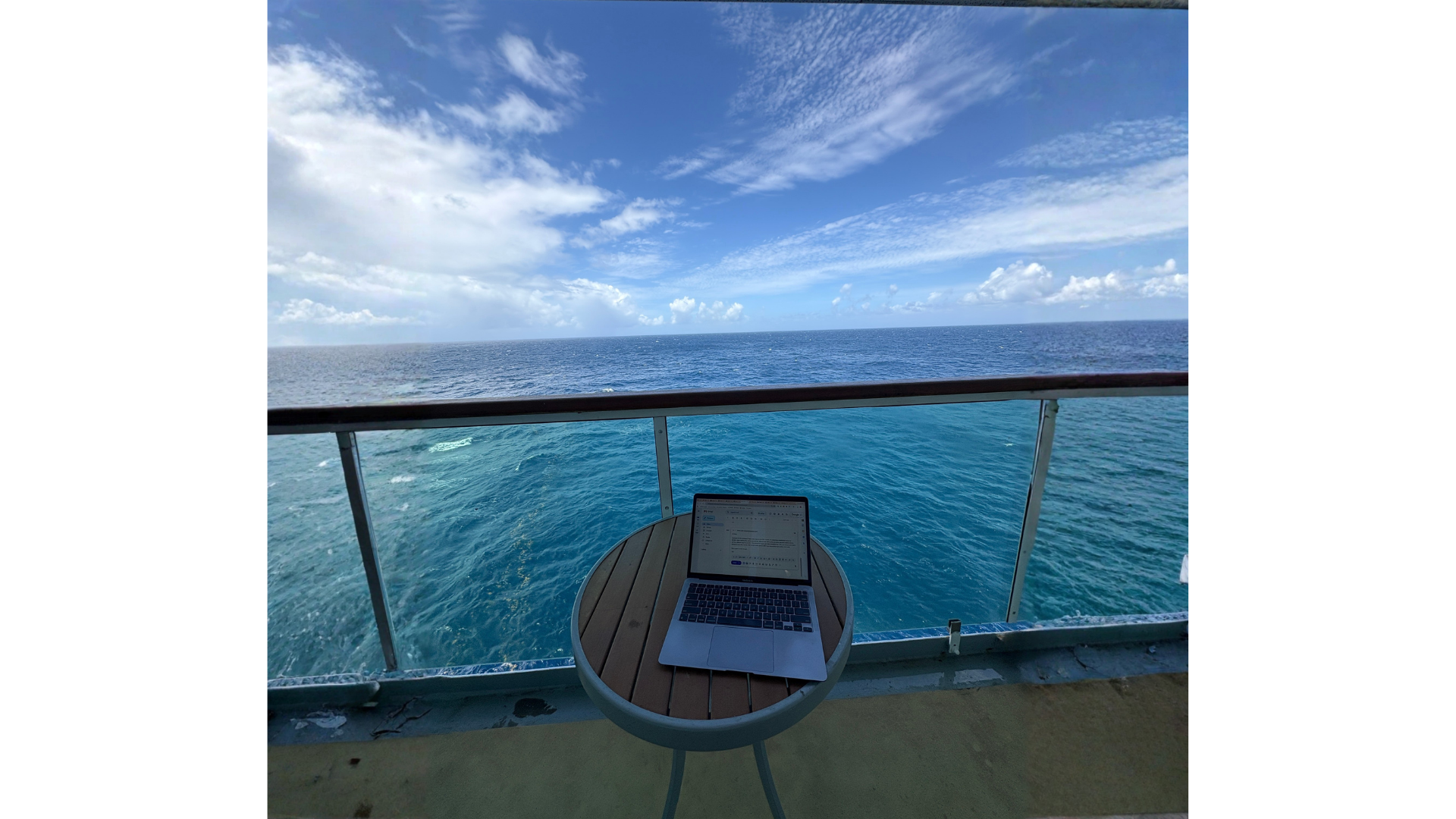
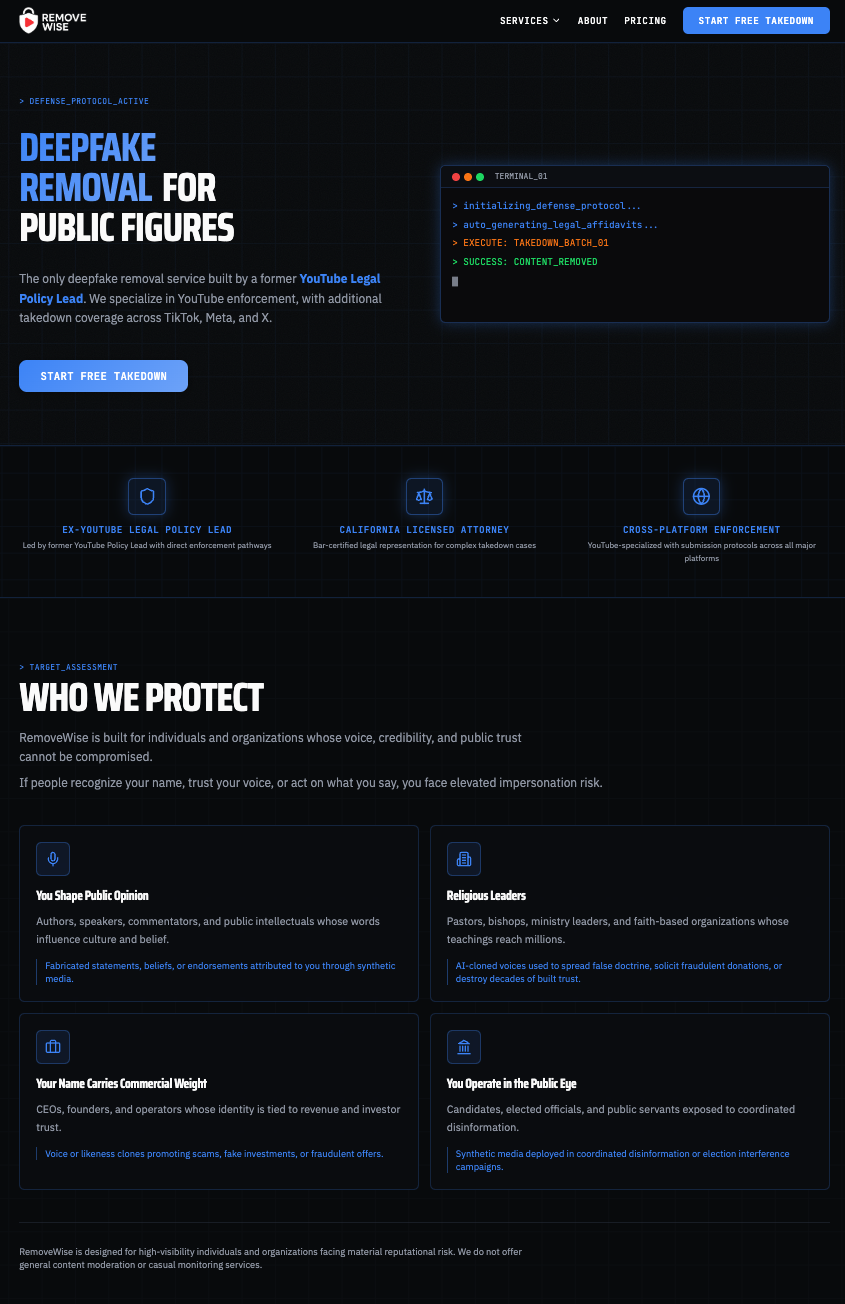
I'm Joseph D'Andre, founder of RemoveWise. We're a deepfake detection and removal service that protects public figures and organizations from AI-generated impersonation content. Our clients are religious organizations, thought leaders, and public figures whose names and faces are being used without permission in fake videos across YouTube, Facebook, TikTok, and scam websites.
I spent four years on YouTube's legal operations team at Google, where I personally helped write their deepfake removal policy. I know exactly how these platforms process takedown requests because I helped build the system from the inside. Today I use that knowledge to protect large organizations and public figures. It's a one person operation with a single contractor, no outside funding, and today we bring in around $21K/month.
How do you come up with the idea for RemoveWise?
I was on YouTube's legal operations team when the AI deepfake boom hit. I watched public figures report fake videos of themselves and get denied because their complaints were missing nuances only someone inside the system would know. Nobody was bridging that gap, and I had four years of insider knowledge on exactly how takedowns actually get processed. To validate the idea I sent five cold emails and got three replies. Anyone who has done cold outreach knows that doesn't usually happen. I was also at a turning point personally. My brother had just passed away suddenly, and I knew I wasn't going to spend the rest of my life working for someone else. So I quit Google and went for it.
How did you build the initial version of RemoveWise?
Joseph D'Andre built RemoveWise by leveraging his insider knowledge from his time at YouTube to develop a deepfake detection and removal service. He used AI coding tools like Cursor and Lovable to build the tech stack, including client dashboards, automated monitoring, and detection workflows. The first prototype was likely focused on efficiently identifying and removing deepfake content, taking around six weeks to build. Challenges included learning to not hide behind email communication and instead confidently ask for calls to close sales, as well as offloading non-revenue-generating tasks to a contractor to focus on client acquisition and closing.
How did you launch RemoveWise and get initial traction?
There was no real launch. No Product Hunt, no press, no social media campaign. I built a website, wrote some blog posts for SEO, and started cold-emailing public figures whose deepfakes I had already found. That was the entire strategy. Six weeks after I sat down and started building, my first Stripe payment hit. The biggest lesson was about imposter syndrome. I was nervous about putting myself out there and failing publicly. But nobody cared. People took me seriously as soon as I showed up with real evidence of their problem and a credible solution. The business didn't need a launch. It needed me to stop overthinking and start emailing.
What was the growth strategy for RemoveWise and how did you scale?
My growth strategy is almost embarrassingly simple: I find public figures who are being deepfaked, and then I email them with proof. That's it. The key is leading with evidence, not a pitch. I don't send a generic cold email saying "deepfakes are a growing threat and you should be worried." I find the specific fake videos of that person, document them with URLs and view counts, and send an email that says "here's what I found." That shifts the conversation immediately. You're not selling. You're flagging a problem they didn't know they had, with receipts.
From there, my outreach is multi-touch. Cold email first, then LinkedIn if I don't hear back. Once a client is onboard, I ask for referrals. The organizations I work with tend to know other organizations with similar problems. Referrals close faster and at higher trust than any cold lead.
I've also invested in SEO through blog content targeting long-tail keywords around deepfake removal. It's a slow burn, but when someone Googles "how to remove a deepfake" and finds my site, they're already problem-aware and ready to buy. My advice for aspiring entrepreneurs: don't be afraid of no. You don't know if someone will say yes without asking, and you don't know where a conversation might lead. A "not right now" can turn into a referral or an introduction six months later. Your job is to expand your surface area and create opportunities for luck and serendipity to find you.
What were the biggest lessons learned from building RemoveWise?
I lost a major client early on because I was too scared to just say "let's hop on a call." I kept the sale over email, which made me look less legitimate and less confident. They moved on. That taught me to stop hiding behind your inbox. Put a face to it. Ask for the call.
One of the best decisions I made was hiring a contractor to handle operational work. It felt scary, having someone who relies on you. But it freed me to focus on the only thing that grows the business: finding and closing clients. Stop wearing "doing everything myself" as a badge of honor and offload anything that isn't generating revenue.
Something that might surprise people: I built my entire tech stack using AI coding tools like Cursor and Lovable. Client dashboards, automated monitoring, detection workflows. I'm not a developer. You don't need to be anymore.
And the biggest mistake I see other founders make is waiting. Overthinking, convincing yourself you'll start next year. The odds of your first idea working are low. That's not a reason to wait. It's a reason to start now and take more shots. Every attempt expands your surface area for luck and serendipity to find you. Life is short. Stop planning and start doing.
Discover Similar Business Ideas Like RemoveWise





More about RemoveWise:
Who is the owner of RemoveWise?
Joseph D’Andre is the founder of RemoveWise.
When did Joseph D’Andre start RemoveWise?
2025
How much money has Joseph D’Andre made from RemoveWise?
Joseph D’Andre started the business in 2025, and currently makes an average of $252K/year.
More Case Studies Like This




Starter Story × HubSpot
Free tools for every part of your business.
Find customers, win deals, and automate the busywork with HubSpot's free tools.