I Make $120K/Month Running Billionaires' Lives
Who are you and what business did you start?
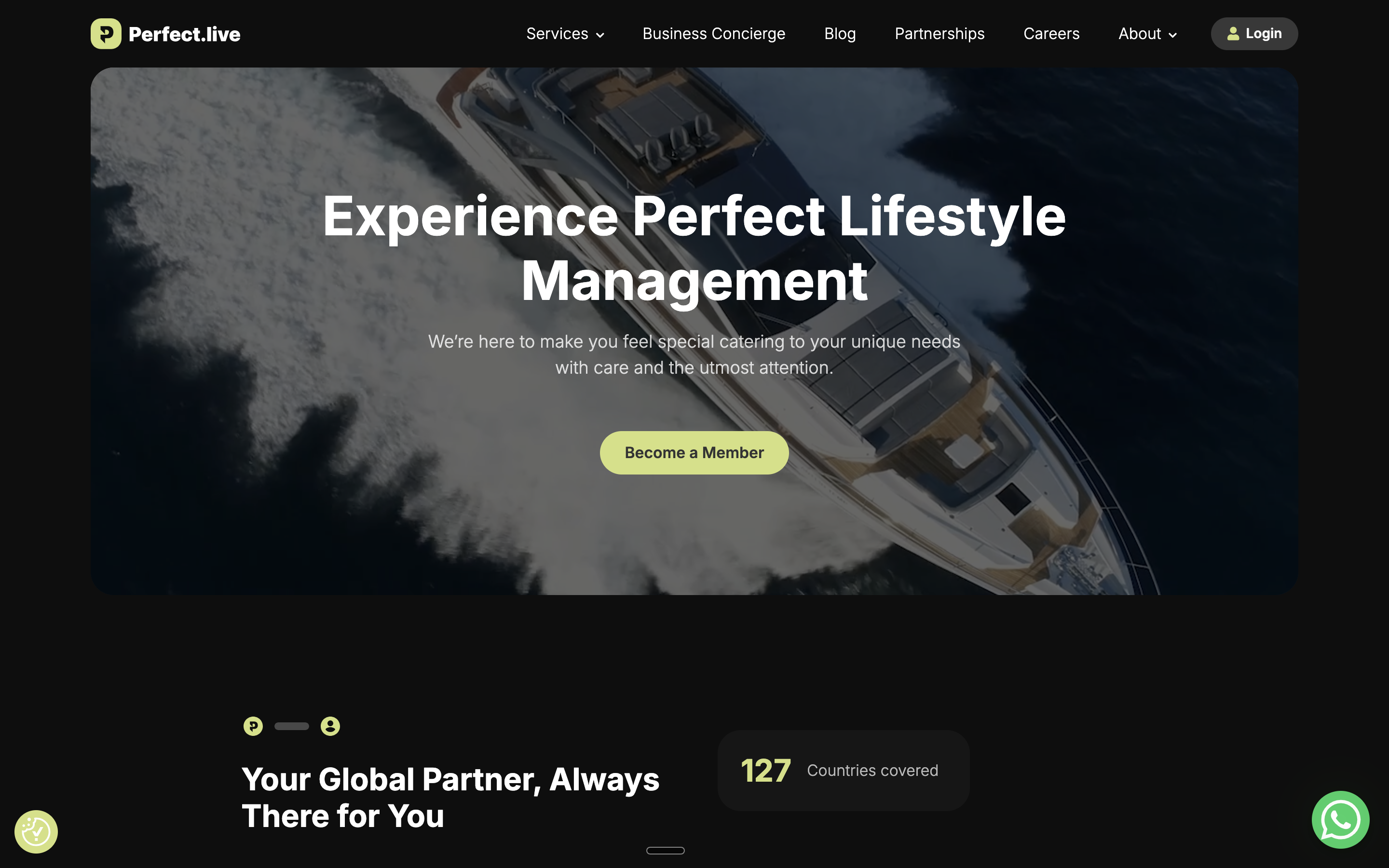
I'm Dmitri Laush, CEO of Perfect.Live. We're building a service for extremely complex HNWIs whose lives require 24/7 management — typically senior executives, serial entrepreneurs, and wealthy families with a large portfolio of high-value assets.
These clients run demanding businesses and high-value assets, and there are only so many hours in the day. So we run the rest of their lives for them, 24/7, on a concierge basis — handling the backend of their complex lives across travel, medical and health, family management, events, and urgent requests at all hours from anywhere in the world.
We also serve private banks, brokerages, and private clubs as embedded infrastructure via our API. Today we cover 127 countries with a team of 100, and we're bringing in around $120K per month in revenue.
How do you come up with the idea for Perfect.Live?
A good portion of my time is spent in business communities and at business events, where I'm constantly around serious operators — extremely busy, high-powered entrepreneurs, venture capitalists, and other very successful people. What surprised me is how many of them don't have a personal assistant. They spend their expensive hours chasing cashback points, booking their own flights, and making hotel reservations themselves.
In conversations across that community, I kept hearing two patterns. The first: highly successful individuals who, for various reasons, operate without a personal assistant at all — handling logistics themselves between meetings. The second was more interesting: people who'd had a personal assistance system in place for years, and when the assistant left, the entire operating system of their life collapsed overnight.
That's when I understood - solving staffing doesn't solve the underlying problem of actually running a complex life alongside a successful business. The realization really sank in after I exited a tech company and started traveling the world. I began using various concierge services for bookings and logistics, and none of them had a real app. None of them had integrations with other services. It was all WhatsApp.
That's what I wanted to fix.
How did you build the initial version of Perfect.Live?
Perfect.Live's product was built through a meticulous development process using advanced technology. The team utilized a sophisticated tech stack and software to create a seamless and efficient service for high-net-worth individuals. The first prototype underwent rigorous testing and iterations before reaching its final form. It took several months to build the initial version, with the experience presenting both challenges and opportunities for growth.
How did you launch Perfect.Live and get initial traction?
Once we'd figured out what we were actually solving, I started by talking to my own network. They already knew I was trying to solve this particular problem for them, their families, and their friends — they'd lived it themselves.
As we were building the company out, our first clients came directly from that network — people who already understood the problem. I'd go to meetings, show them what we were building, and run it all manually for them. The first paying client came about three months in, through a warm introduction. Honestly, part of why it took that long is that I was scared to charge.
We learned a lot from those early clients, but one lesson stood out: every client who pushed hardest on price turned out to be the least loyal and the most difficult to work with. The clients who paid full price without negotiating were, by far, the best — the most demanding in the right way, and the most worthwhile to serve. The pattern was clear: the best clients were the ones who were already friends, where you were simply trying to do a great job for them.
Our customers are the people who genuinely want this to work. They're the foundation of everything we've built.
What was the growth strategy for Perfect.Live and how did you scale?
We did test a consumer-facing product early on, and as we suspected, it didn't work. Plenty of people were curious about the idea of an app that automates parts of a high-end lifestyle — but very few of them were actually dealing with the problem we were built to solve. Consumer marketing brought in the wrong kind of people for us: interested in the concept, not invested in the problem.
The shift came when we moved to institutions — private banks, brokerages, family offices. They already have the clients. They already have a trust relationship. They just aren't serving those clients at the lifestyle layer. We become the infrastructure they offer under their own brand.
B2B sales are generally longer than B2C sales but the end contracts are much more valuable and the churn rate is virtually non-existent. We sell to institutions; they, in turn, deliver the service to their customers — so we don't need to spend on advertising to end users at all. Our clients don't respond to ads, instead, they respond to reputation. The channels that have worked for us are earned media, articles, interviews, and being in the right rooms.
One thing I'd tell any early-stage founder: figure out which channel actually has a signal for your business, and then do that one thing extremely well until it works. We spent months building out a couple of consumer-facing approaches before accepting they weren't going to work for us. The lesson was to stop spreading effort across channels that look promising and concentrate everything on the one that's actually moving.
What were the biggest lessons learned from building Perfect.Live?
My biggest mistake was continuing with things that seemed to be working even when they weren't. Cutting loose the things that aren't working is much harder than it sounds — there's always a reason to give them one more quarter.
The best decision we made was going B2B early. The unit economics of consumer vs. B2B for us are worlds apart, and the caliber of customer is incomparably better. The clients are more serious, the contracts are larger, and the churn is almost nothing.
What I didn't control but benefited from was timing. The AI infrastructure that existed by 2022 finally made it possible to build what I'd been describing for years. Luck is real — but you have to be positioned to use it when it arrives.
As a founder, the moments when things suddenly start working are almost always unexpected — some shift in the market or in customer behavior that you didn't plan for. You only notice these shifts early enough to capitalize on them if you're already deeply embedded in your customers' day-to-day problems.
Perfect.Live Acquisition: How much did Perfect.Live sell for and what was the acquisition price?
N/A. Still building.
Discover Similar Business Ideas Like Perfect.Live
|
|
Idea
|
Revenue
|
|---|---|---|
|
High-end escort service offering the Girlfriend Experience. |
$250K /mo | |
|
Online education for aspiring book publishers. |
$120K /mo | |
|
Resume and LinkedIn writing for job seekers. |
$2K /mo | |
|
Crime and trauma scene cleanup franchise. |
$1.25M /mo | |
|
Local and corporate transportation with top-notch service. |
$250K /mo | |
|
Blog proofreading service for content creators. |
$2K /mo | |
|
Mobile locker rentals for event-goers. |
$34K /mo |







More about Perfect.Live:
Who is the owner of Perfect.Live?
Dmitri Laush is the founder of Perfect.Live.
When did Dmitri Laush start Perfect.Live?
2022
How much money has Dmitri Laush made from Perfect.Live?
Dmitri Laush started the business in 2022, and currently makes an average of $1.44M/year.
More Case Studies Like This



Starter Story × HubSpot
Free tools for every part of your business.
Find customers, win deals, and automate the busywork with HubSpot's free tools.