How I Built A $13K/Month Enterprise AI Control Platform
Who are you and what business did you start?
I’m Jake Tao, Founder and CEO of Syrovex, the company behind OwlVigil. I have spent more than 20 years building software, including 15 years developing and scaling enterprise systems at companies such as Amazon, Shopify, Capital One, Grab, Oracle, and Alibaba. In March 2026, I began building Syrovex to help businesses adopt AI without losing visibility or control. Our primary customers are enterprises deploying AI across multiple models, applications, teams, and workflows.
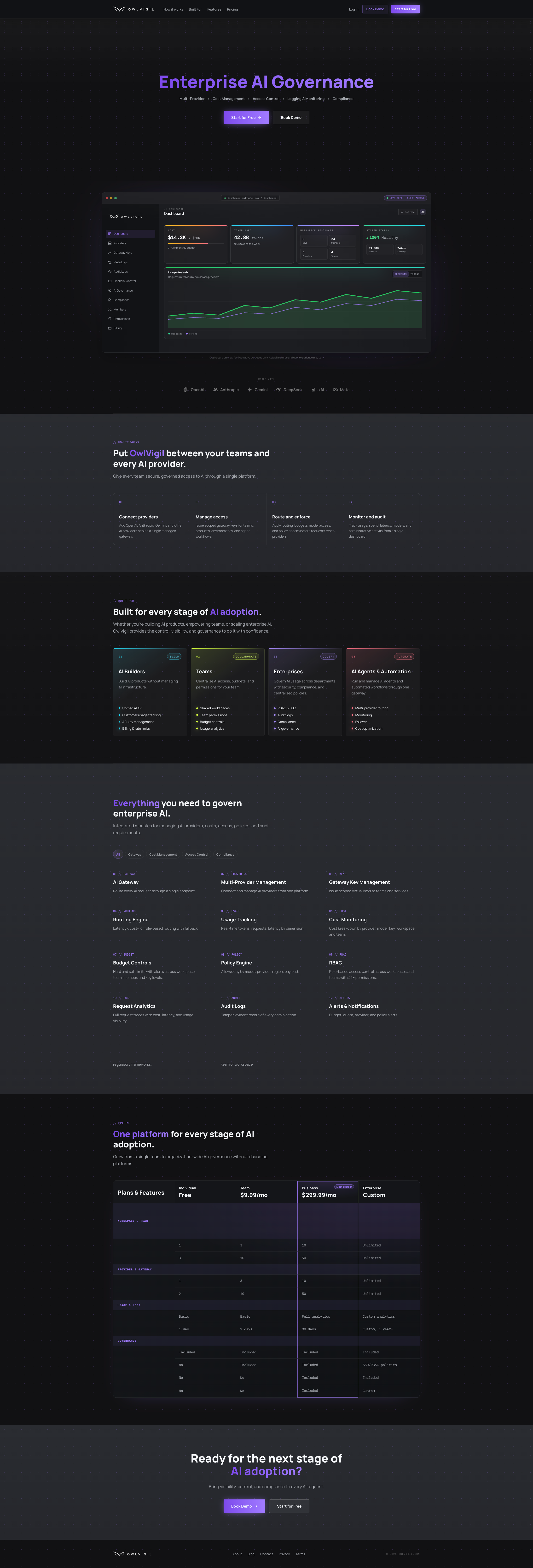
OwlVigil, our core product, is a provider-agnostic enterprise AI control plane that gives companies one place to manage AI access, usage, costs, policies, and compliance. Unlike tools tied to a single cloud or model provider, OwlVigil works across the entire AI stack and integrates with existing applications without requiring companies to rebuild their infrastructure. Within our first few months, we secured 16 paying customers, including four paid enterprise engagements, and signed $230,000 in customer contracts. Today, we generate approximately $2,000 in monthly recurring revenue, alongside revenue from enterprise implementations.
How do you come up with the idea for OwlVigil?
The idea for Syrovex grew out of a pattern I kept seeing as AI adoption accelerated. Companies were adding more AI models, applications, and vendors, but the systems managing access, cost, usage, security, and compliance remained fragmented. The “aha” moment came when my own team began running into exactly the same problems. We could build AI functionality quickly, but answering basic operational questions—who was using which model, how much it cost, what data was being sent, and whether the right policies were being enforced—was surprisingly difficult. I realized this was not simply an internal engineering problem; it was an emerging enterprise infrastructure problem.
This idea stood out from other opportunities I had considered because it combined a recurring customer pain point with my own experience. I have spent more than 20 years building software, including 15 years working on large-scale enterprise, cloud, data, financial, and advertising systems at companies such as Amazon, Shopify, Capital One, Grab, Oracle, and Alibaba. I began developing OwlVigil in March 2026 and validated the idea by speaking directly with businesses in industries including legal services, staffing, warehousing, and sales. Instead of only asking whether they liked the concept, I invited them to become design partners and commit time and money to solving specific use cases with us. Within our first few months, we secured five design partners, completed four paid enterprise engagements, and signed $230,000 in customer contracts. Their willingness to pay—and their requests to expand the initial deployments—gave me confidence that we were solving a meaningful problem rather than building technology in search of one.
How did you launch OwlVigil and get initial traction?
We did not launch Syrovex with a large public announcement. I began building OwlVigil in March 2026, and after incorporating Syrovex in June, I started with founder-led outreach: speaking with people in my network, contacting companies already deploying AI, demonstrating an early version of the product, and writing about the problems we were solving. Rather than asking companies to buy a finished platform immediately, I invited a small number of them to become design partners. This allowed us to begin with a specific operational problem, build alongside the customer, and expand the engagement as we demonstrated value.
Our first dollar came from one of these conversations. A company had a real AI workflow it wanted to deploy but needed help making it reliable, observable, and controllable. We scoped the problem as a paid engagement and used what we learned to improve the broader OwlVigil platform. We generated our first revenue within roughly two months of beginning customer outreach. That initial work led to more introductions, and within our first few months, we had secured five design partners, completed four paid enterprise engagements, and signed $230,000 in customer contracts.
The response was encouraging, but it also exposed an early challenge: “enterprise AI control plane” could sound abstract to customers. The conversations became much more effective when I stopped leading with the platform category and instead focused on immediate questions—How much are you spending on AI? Who has access? What data is being sent? Can you enforce policies across every application? Once customers saw OwlVigil applied to their own workflows, they understood its value, and every enterprise customer we worked with asked about expanding the initial deployment.
The biggest lesson was that an early-stage launch is less about attracting the largest possible audience and more about finding a small number of customers with urgent problems. I would use the same founder-led, design-partner approach again because it gave us fast feedback and early revenue. If I could change one thing, I would define our initial customer profile and explain the relationship between Syrovex, the company, and OwlVigil, its core product, more clearly from the beginning.
What was the growth strategy for OwlVigil and how did you scale?
Our early growth has come from four channels: founder-led sales, customer referrals, design partnerships, and technical content. Because enterprise AI infrastructure is a high-trust purchase, I initially prioritized direct conversations over paid advertising. I contacted founders, engineering leaders, and companies already deploying AI through my professional network, warm introductions, LinkedIn, and targeted email outreach. Instead of opening with a broad product pitch, I asked how they were managing AI access, costs, usage, and compliance. Those conversations helped us secure five design partners across legal services, staffing, warehousing, and sales, and frequently led to paid implementations, expanded deployments, or introductions to other companies.
Our design partners have also become an important distribution channel. They contribute industry knowledge, help us validate specific workflows, and can introduce the resulting products to other businesses in their sectors. This works particularly well because an enterprise customer is more likely to trust a solution developed with someone who understands its industry than a generic AI product built without direct customer involvement.
Technical content is our main inbound strategy. I publish practical articles about AI infrastructure, APIs, agents, governance, and cost optimization on our websites, then distribute selected pieces through LinkedIn, Medium, DEV.to, HackerNoon, Hashnode, and other developer communities. We use these channels because engineers and technical leaders often experience the problems OwlVigil solves before those problems become executive priorities. Publishing on our own sites also creates a long-term SEO foundation, while external platforms help us reach established technical audiences. More recently, we released our Go SDK as open source, giving developers a low-friction way to experience OwlVigil before considering a larger deployment.
One example was our article comparing OpenAI’s Responses API with the older Chat Completions API. Rather than promoting OwlVigil directly, we explained a timely technical change and helped developers understand how to adapt. HackerNoon selected it as the number-two story in its weekly roundup and included it in its podcast. The immediate exposure was valuable, but the larger benefit was credibility: readers could see that we understood the infrastructure changes affecting their work. For a technical company, useful education can start better customer conversations than conventional advertising.
The most important lesson I have learned is that early-stage founders do not need to be active on every channel. They need to understand where their customers already spend time and consistently contribute something valuable there. I recommend beginning with direct customer conversations, documenting the questions that appear repeatedly, and turning those questions into useful content, product features, and sales messages. If a piece of content receives little attention but helps close one meaningful enterprise conversation, it may be more valuable than a viral post that reaches the wrong audience.
What were the biggest lessons learned from building OwlVigil?
One of the biggest lessons I have learned is that building a strong product is only part of building a business. As a technical founder, my natural instinct is to solve problems by building. Early on, I sometimes spent too much time improving the product before confirming which problems customers considered urgent enough to pay for. I learned that positive feedback is not the same as validation. A much stronger signal is whether a customer will commit money, time, data, or internal resources to solving the problem with you.
I also learned that a large platform vision must be introduced through a narrow, concrete use case. “Enterprise AI control plane” accurately describes OwlVigil, but it can feel abstract during an initial conversation. Customers respond more strongly when I begin with a problem they already recognize: an unexpected AI bill, inconsistent access controls, missing audit logs, or an AI workflow that cannot safely move into production. Once we solve that immediate problem, it becomes much easier to show the value of a broader platform.
One of our best decisions was working with paid design partners rather than developing the entire platform in isolation. They helped us understand how the same underlying AI governance problems appeared differently in legal services, staffing, warehousing, and sales. However, this approach introduced another challenge: distinguishing reusable product requirements from customer-specific requests. I had to learn that listening to customers does not mean building everything they request. The goal is to identify the common infrastructure underneath their individual problems and turn that into a scalable product.
Timing has also helped us. We did not create the rapid adoption of generative AI, but it has made the need for visibility, cost management, security, and governance increasingly urgent. At the same time, that trend creates risk because models, vendors, and customer expectations change quickly. We designed OwlVigil to be provider-agnostic for that reason. Instead of betting the company on one model provider, we built around the more durable enterprise need to manage AI across providers, applications, and teams.
A skill that has helped me throughout my career is turning complex, emerging technologies into practical products that solve real business problems. Still, I have had to become more deliberate about sales, positioning, partnerships, and distribution. I now treat customer conversations as part of product development rather than something that happens after the product is finished.
My advice to other founders is to talk to customers before you feel ready, ask for commitment instead of compliments, and describe the customer’s immediate problem before explaining your long-term vision. Do not mistake a polished product for a complete business, and do not try to use every marketing channel at once. Find a small group of customers with an urgent need, solve it exceptionally well, and use what you learn to build both the product and the distribution around it.
OwlVigil Acquisition: How much did OwlVigil sell for and what was the acquisition price?
N/A
Discover Similar Business Ideas Like OwlVigil




More about OwlVigil:
Who is the owner of OwlVigil?
Jake Tao is the founder of OwlVigil.
When did Jake Tao start OwlVigil?
2026
How much money has Jake Tao made from OwlVigil?
Jake Tao started the business in 2026, and currently makes an average of $156K/year.
More Case Studies Like This



Starter Story × HubSpot
Free tools for every part of your business.
Find customers, win deals, and automate the busywork with HubSpot's free tools.