I Built an AI Agent That Makes $10K/Month
Who are you and what business did you start?
I'm Ivan Nedelkovski, co-founder @ Lancer.
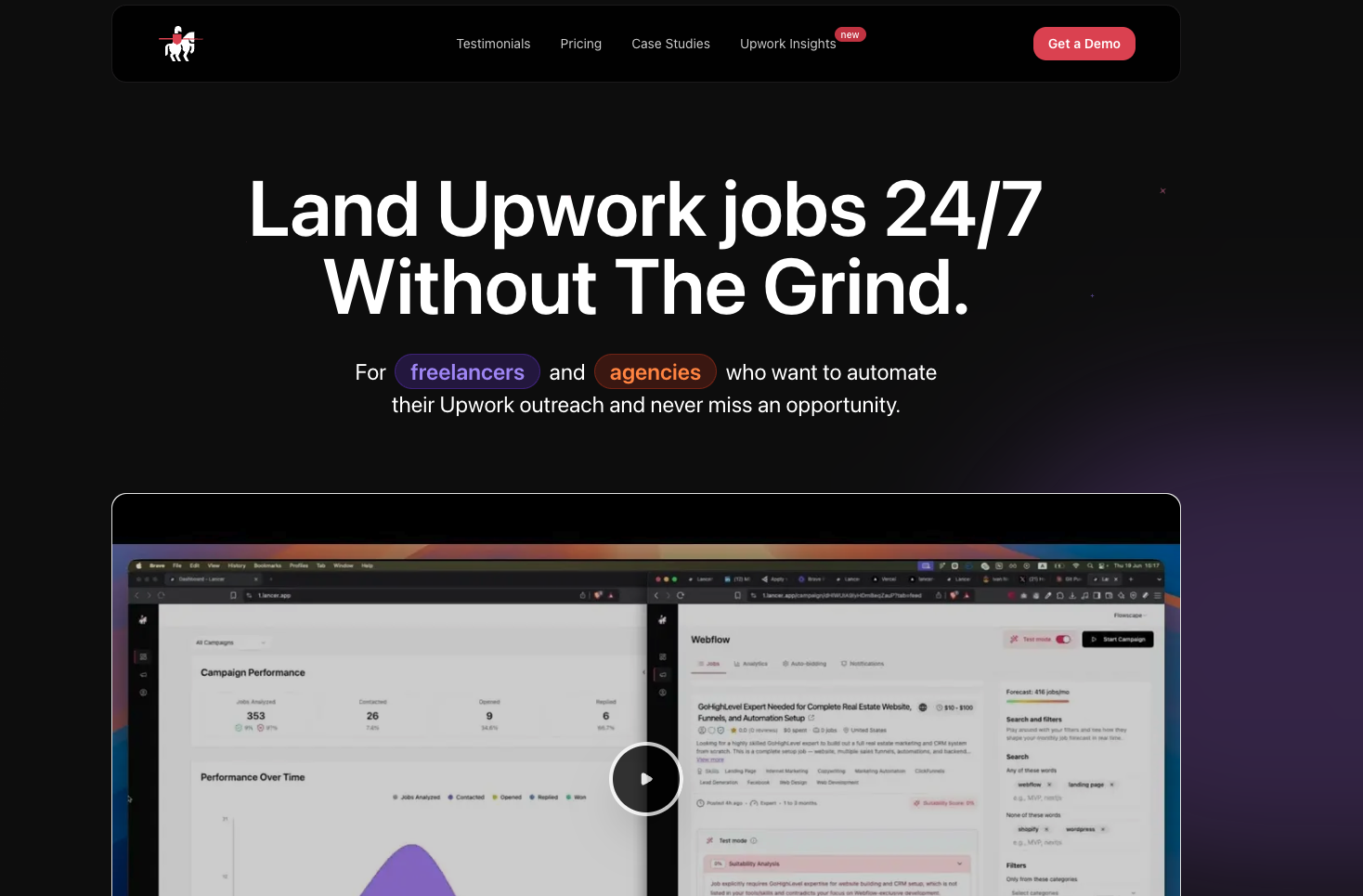
Lancer is an AI Agent that automates the process of job discovery, qualification and bidding on Upwork - essentially turning the platform into an automated acquisition channel.
Since Lancer works 24/7 it allows our users to enjoy up to 10 extra hours a week not having to monitor Upwork, write and send proposals.
Outside of saving time Lancer increases our users' reply rate since it sends a personalized proposal within the first 10 minutes of a job going up - increasing the chances the client views their proposal.
We launched in June 2025 and 3 months later we were profitable hitting our first $10K month.
How do you come up with the idea for Lancer?
The idea came from solving my own problem, I've been running a Dev Shop called MVP Masters for the past 5 years.
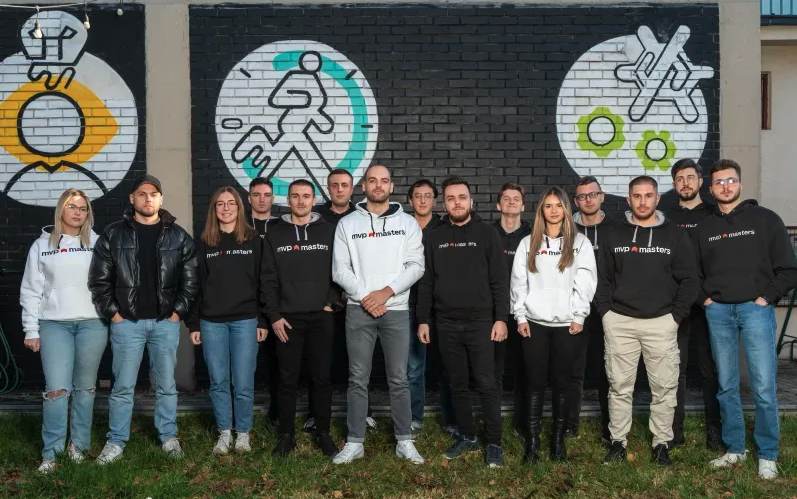
MVP Masters Team
As anyone running an agency knows, the hardest part of scaling an agency is building a consistent flow of leads, for the first 3 years of MVP Masters, we only relied on unreliable channels such as referrals or a few affiliates.
Last year (2024) I gave Upwork a chance with a brand new account, within one quarter and only having invested $800 into the platform we closed 3 contracts which eventually generated $240,000 for the agency in the next 12 months.
I was sold on Upwork - however the process of job discovery, qualification and bidding was killing me and I felt it was broken. 10,000 jobs are posted on Upwork each day spread across 24 hours, so there is no way you can monitor all of this yourself manually.
I would spend the first 2 hours of each day looking for the right jobs and bidding on them - then my productivity for the rest of the day was shot. And I was missing a ton of opportunities.
Essentially my coverage was 2/24 -> or 8% of all opportunities. A tool that automates all of this made total sense.
So I built a prototype just for myself to see if it will help - it did, then I invited a few friends that were agency owners to test it out - they both closed clients within the first week with it.
That’s when I knew we had something.
How did you build the initial version of Lancer?
Ivan Nedelkovski built Lancer by first creating a prototype to solve his own problem of job discovery, qualification, and bidding on Upwork. He used his experience running a Dev Shop to identify the inefficiencies in the process. The product was built with a tech stack that was focused on automating job searches and sending personalized proposals quickly. The first version took around 5 months to build and was initially tested by Ivan and a few friends who were agency owners. The experience of building the product was challenging but validating, as it led to paying users within a short period of time without much working and constant issues.
How did you launch Lancer and get initial traction?
We got the first users through my network - I shared a LinkedIn Post asking for beta testers and highlighted some of the stats we were able to achieve ourselves.
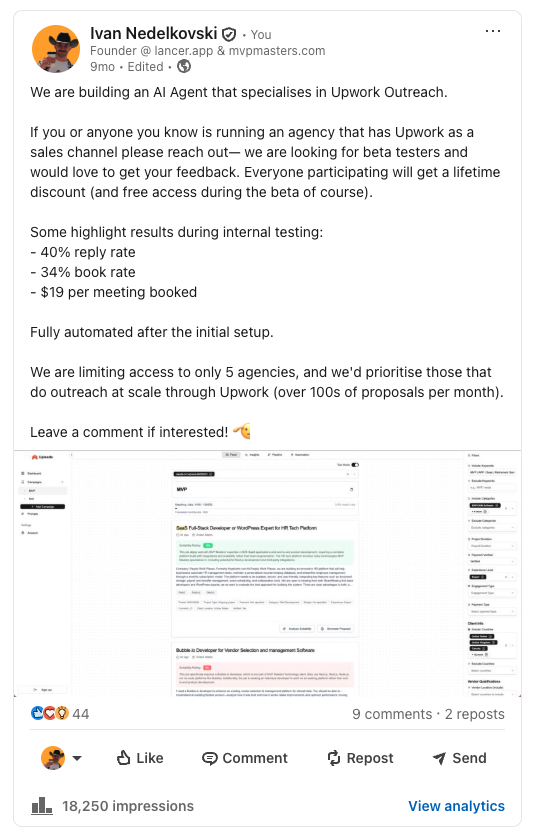
The Initial LinkedIn Post
Three of them closed clients with Lancer within a week - this was a huge validation for us - and also we were able to bill them a month later.
We actually monetized Lancer and we had around $800 MRR before launching!!!
I knew this was a big outlier because I had a front-row seat to all the products we launched for our clients as part of MVP Masters where clients would spent hundreds of thousands of dollars and in some cases more than a year building the 'perfect product' they envisioned just to launch and never monetize.
And here we were 5 months after writing the first line of code we had paying users - almost nothing was working, everything was breaking, but we had built something people were willing to pay for - and a premium SaaS price at that - around $300/m.
What was the growth strategy for Lancer and how did you scale?
Honestly, we have yet to pull any true growth levers for Lancer. We've been focusing on the product side of things and growing somewhat organically.
We haven't spent a single dollar on paid acquisition and we are hovering around $10K MRR for the past few months.
The biggest movers have been reaching out to few of the biggest 'Upwork Experts' and demoing our product.
'Upwork Experts' are freelancers themselves which help either agency owners or other freelancers get setup on Upwork or optimize their profile on there and help with strategy in order to help them win more.
As part of their offering they have an upsell addressing the issue of job discovery, qualification and bidding I mentioned above - if you are serious about what you do, there's no way you can even spend hours a day doing this so you want to outsource it.
One of the Upwork Experts I approached recommended their clients to a team of manual bidders in Pakistan, another to an established competitor.
After I demoed Lancer to them they switched to recommending it as a solution for the bidding process on Upwork to their clients.
Most of our growth came from those two experts as affiliates. The other growth channels have been me posting on LinkedIn about it, and also (this one is fun) I created a new Upwork profile specialized for 'Upwork Bidding' and then applied to Upwork Jobs looking for manual bidders using Lancer.
Essentially using Lancer to sell them Lancer - once they realized what was happening it was an easy sell.
What were the biggest lessons learned from building Lancer?
I might have a rare perspective to share when it comes to comparing a service-based business I've ran (MVP Masters) and having started a SaaS business (Lancer) now.
A service-based business is much easier to bootstrap, to grow linearly and at a certain pace - it's essentially perfect for a lifestyle business.
Agency
You can stay as a solopreneur and become a great consultant increasing your income by raising prices, or you can team up with someone, start hiring and build a team in order to acquire some leverage (still linear).
Growth is linear and predictable and somewhat controlled.
Contracts are long and predictable, and there's relationship building with clients, very rarely do you lose a client to a different vendor if you are good at what you do.
SaaS
In SaaS we have the dreaded 'Churn'.
Someone told me a few years back, "in SaaS you either grow or you die".
There are no contracts, no vendor lock-in, no relationship-building. Just a $300/m subscription and a WhatsApp support chat, that's how much you know about your users and that's how much you can afford.
Because if you can get to $80K/m with 6 - 10 clients as an agency, you need 300 for a SaaS, you just can't provide the same level of customer care.
So you must build systems, a great product, and a constant acquisition channel - because there will always be churn.
You can get away not acquiring a customer for months at at time with an agency, with a SaaS product that's a suicide.
Reaching scale is the only way you win with SaaS, with an agency you can win staying small.
Lancer Acquisition: How much did Lancer sell for and what was the acquisition price?
No acquisition has been made - although we've gotten several offers between $100K - $150K after we submitted our Startup on Marc Lou's TrustMRR
Discover Similar Business Ideas Like Lancer






More about Lancer:
Who is the owner of Lancer?
Ivan is the founder of Lancer.
When did Ivan start Lancer?
2025
How much money has Ivan made from Lancer?
Ivan started the business in 2025, and currently makes an average of $120K/year.
More Case Studies Like This





Starter Story × HubSpot
Free tools for every part of your business.
Find customers, win deals, and automate the busywork with HubSpot's free tools.