How I Started A $15K/Month Product Analytics Consultancy For SaaS Startups
Who are you and what business did you start?
I'm Ansh, and I run Datalyze, a product analytics consultancy. Before this, I worked on analytics at CRED. Since 2021, we've worked with 150+ startups from Seed to Series C, across the globe.
Our clients are mainly B2B SaaS and fintech companies, plus some consumer apps.
Most of them come to us with the same problem. They set up Mixpanel or PostHog, tracked events for months, and still don't trust the numbers. We fix the tracking, bring their data into one place, and clean it up so their team gets the right answers. This matters more now because of AI. If the data going in is wrong, every report and every AI tool built on it is wrong too.
We're a team of 5, and today we bring in around $15K a month.
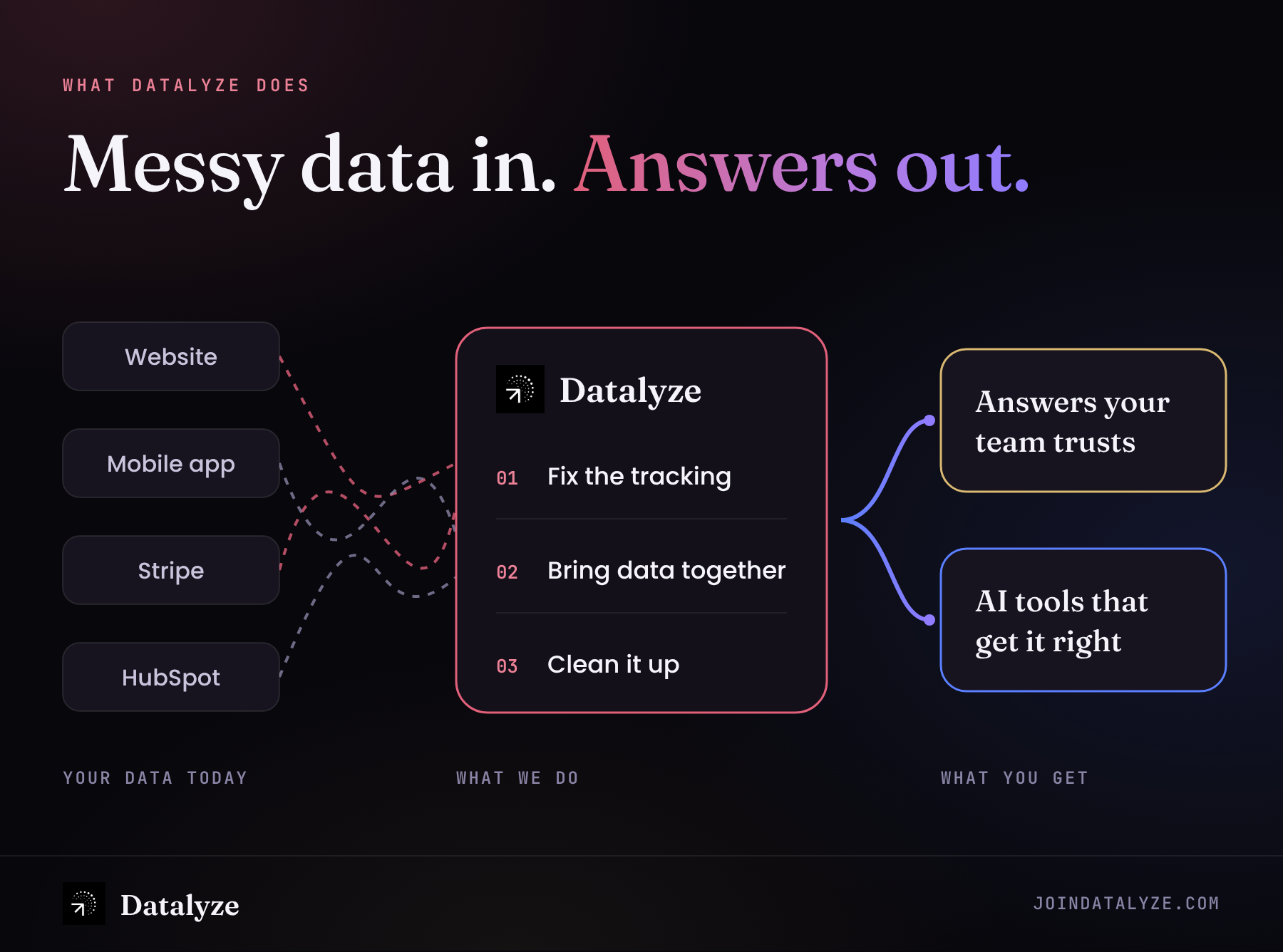
What we do at Datalyze: fix the tracking, bring the data together, and clean it up so teams can trust their numbers.
How do you come up with the idea for Datalyze?
In college, I was building a mental health social app called RealTalk. It was free, and the road to revenue was very long. I learned a lot, but I could never make it pay.
At the same time, I got into data. I was studying mathematics and computing at a tech college. I didn't want to write code all day, I didn't enjoy machine learning, and I didn't want to go into consulting.
Data sat right in the middle, and honestly, it came easily to me. I never took a course. I taught myself through projects, did a couple of unpaid internships, and then a few paid ones.
In my final year, I shut the app down. Just before joining CRED full time, I thought, why not try freelancing for a bit and make some extra money? So I made an Upwork profile.
It was slow at first. It took me 3 weeks to land my first client. Six months in, I was doing analytics at CRED during the day and taking Upwork projects on the side.
The aha moment came about a year in. I looked at my numbers and saw I was making more from freelancing than from my job. Freelancing also gave me control over my own time. I always knew I wasn't cut out for a job. Now I had proof that I didn't need one. So I quit and went full time.
This was different from my earlier ideas for one simple reason: it made money from day one. With the app, I was always chasing revenue. With a service business, you get paid from the first project.
That's also how I validated it. Before I quit, I had 5 paying clients and a Top Rated profile on Upwork. That was enough to take the leap.
In 2021, I started Datalyze, and it grew from just me into a team of 5.
How did you launch Datalyze and get initial traction?
There was no real launch. Datalyze grew out of my freelancing. When I went full time, I picked a name, put up a website and posted about it on LinkedIn.
Most people who saw it already knew what I did, so nothing changed overnight. In a service business, the trust you build over time matters much more than a launch day.
The real start was on Upwork, about a year earlier. When I made my profile, I applied to a lot of jobs and heard nothing back. I sent around 15 to 20 proposals before anyone replied.
Three weeks in, I got my first job. It paid $100 for 5 to 6 hours of work. It was underpaid, and I knew it. I took it anyway because I needed that first review more than I needed the money.
That job gave me confidence. I kept applying every day, and the reviews slowly added up. After a while, I didn't need to apply at all. Clients came to me, and I was getting 4 to 5 invites a month.
The bigger lesson came later. Early on, I was young and a bit foolish. I wanted to finish the work fast, close the contract and get paid. That works for a while, but you can't build a business on one-time projects done at the minimum.
So I changed how I worked. I started putting in extra time to make sure every client was happy with the result, even when the contract didn't ask for it.
That's what turned one-time projects into monthly retainers. Clients who hired me for one job started asking me to stay on. Today, about 90% of our revenue comes from retainers.
What I learned: stop chasing the money. Focus on the quality of the work and the people you work with. The money follows.
What was the growth strategy for Datalyze and how did you scale?
I'll be honest: I'm probably the worst at marketing. For years, I struggled to find a steady way to get clients.
From 2021 to 2024, almost everything came from Upwork. My profile kept getting stronger, the projects got better, and revenue grew every year. That was the good phase.
At the same time, I tried everything else. I posted on LinkedIn and Twitter. I joined the Mixpanel, Amplitude and PostHog communities and answered questions. I hired agencies to run outreach. Over the years, we sent more than 40,000 cold emails and LinkedIn messages. Almost none of it turned into clients.
It took me a while to understand why. Every company needs a developer, a designer or a marketer. Very few need a data partner at any given moment. So no matter how many companies you contact, very few of them have the problem right then. Cold outreach doesn't work when the need is that rare.
Then, around 2025, Upwork dried up. I barely got any leads from it, and I had no backup channel. It was a stressful time. What saved me was the retainers. Monthly clients kept revenue steady while I worked out what to do next.
Two things worked: 1. The Mixpanel partnership. I became a Mixpanel Certified Partner, and Mixpanel started referring clients who needed help with their setup. 5 clients have come through this so far. These leads are the best kind: they already have the problem, and someone they trust sent them to us.
- SEO and AI search. I always put SEO off as "something for later." It felt too slow. This year I finally committed. We built pages on joindatalyze.com for each tool, each industry and each problem we solve. Now clients find us on Google and through AI. One client found us by searching "Mixpanel consultant" and signed a $3,500/month retainer.
The reason both work is the same. They reach people at the exact moment they need help, instead of interrupting people who don't.
My advice for anyone starting a service business: - Solve your lead flow first. It's the main problem in any service business. Figure out which channel works for you. Test quickly and drop what fails.
Never depend on one channel. I got comfortable while Upwork was working. I should have been building other channels back then. I never thought Upwork would stop working, but it did. If your only channel dies, so does your pipeline.
Match the channel to how often people need you. If your service is something few people need at any given moment, be easy to find. Don't try to be loud.
Today, no matter how much revenue we're making, I spend time every week on SEO. I don't want to be caught with one channel again.
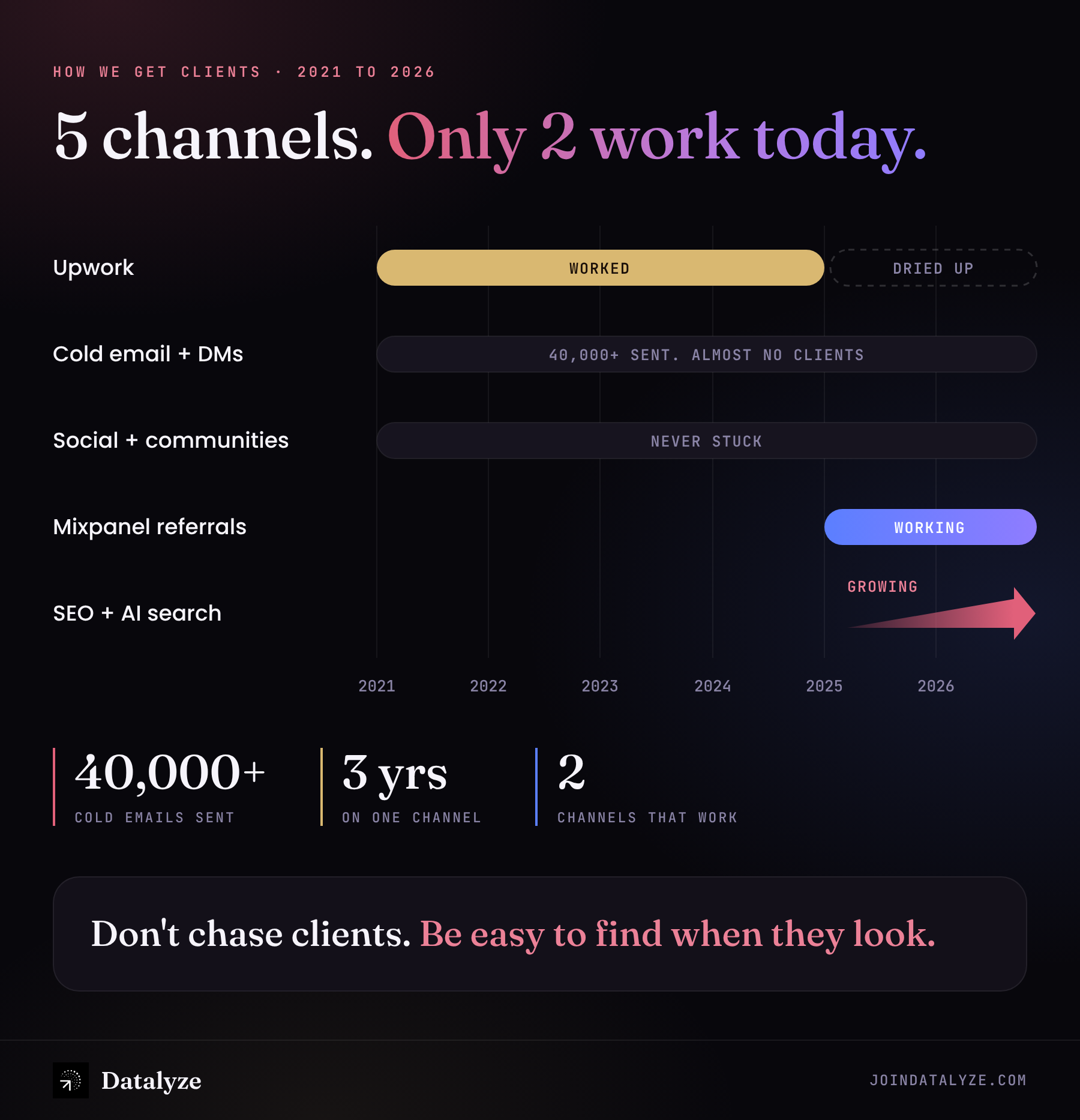
Where our clients came from over 5 years. Most of what I tried didn’t work. Two channels did.
What were the biggest lessons learned from building Datalyze?
I've kept the same weekday routine for almost 7 years. I wake up at 6 and work out. I start work at 9 and keep going until 9 or 10 at night. Then I see a few friends and go to sleep. I do this five days a week. On weekends, I don't work at all.
That routine has done more for Datalyze than any single tactic. It keeps me focused, and it gives me time every day to think about the business, not just work in it. Taking weekends fully off is what makes the weekdays possible.
I also got lucky with timing. When I started freelancing, Upwork was booming and companies were hiring remote help faster than ever. I didn't plan that. I just happened to be there.
If you're starting out, you don't need a big launch or a perfect idea. Show up every day, do work your clients can't stop talking about, and make sure people can find you.
Discover Similar Business Ideas Like Datalyze





More about Datalyze:
Who is the owner of Datalyze?
Ansh Agrawal is the founder of Datalyze.
When did Ansh Agrawal start Datalyze?
2021
How much money has Ansh Agrawal made from Datalyze?
Ansh Agrawal started the business in 2021, and currently makes an average of $180K/year.
More Case Studies Like This




Starter Story × HubSpot
Free tools for every part of your business.
Find customers, win deals, and automate the busywork with HubSpot's free tools.