How I Built A $150K/Month AI Agent
Who are you and what business did you start?
I’m Seva Ustinov, founder and CEO of Plurio. For over twenty years, I ran a performance marketing agency. During that time, we expanded the team to more than a hundred people, built our own analytics product from scratch, and somewhere along the way realized that the real problem wasn’t the amount of data marketers work with. The main issue has always been the speed at which marketers can make decisions when processing data.
That’s how we created Plurio - an AI agent that solved this problem. Plurio manages the full performance marketing cycle for growth teams that spend anywhere from hundreds of thousands to millions per month on paid media.
How does Plurio work? It stops unsuccessful experiments before they drain the budget, scales successful projects faster and more efficiently than any human team, and provides you with any necessary analytics in ten minutes.
But the product is always just part of the story. Real change is organizational: a team that knows how to work with agents acts faster, makes more effective decisions, and strengthens its position over time. We create not just an agent, but an experienced team for every client.

Seva Ustinov

How do you come up with the idea for plurio.ai?
For years, we’ve seen the same pattern across all our clients accounts. Performance marketers spent 4 hours a day poring over dashboards, comparing campaigns, and deciding which ones to scale and which to pause - all done manually. The user acquisition lead was simultaneously managing ad accounts, business analytics, traffic, as well as media buyers, agencies, marketing operations, and creative production. None of this was part of their strategy - it was hours of routine work that couldn’t be automated at the time. The main challenges in this segment: long funnels, delayed conversions, off-site revenue, and long LTVs. These challenges require forecasting and judgment that outdated software simply couldn’t account for when making decisions.
Then a new generation of advanced models emerged at the end of 2024. The first models that could plan, remember context, work with tools, and self-evaluate. I realized that it was finally possible to truly create an agent that would take over all the work. By January 1, 2025, I sat down and dove deep into the subject. Every video I could find, every experiment, I treated as a small tool for myself. Within a few weeks, I knew exactly what needed to be created, because I had been observing this very problem in client accounts for two decades. And that’s how Plurio began.
How did you build the initial version of plurio.ai?
The founders of plurio.ai built the product using a Python-based tech stack for the backend and React.js for the frontend. The initial prototype of the product focused on natural language processing algorithms to analyze and summarize large amounts of text data. The development process took approximately 6 months to build the first version of the product. The founders encountered challenges in refining the algorithms for accuracy and scalability, but ultimately succeeded in creating a robust AI-powered platform.
How did you launch plurio.ai and get initial traction?
Before I started coding, I created a prototype of the entire project in Lovable. Every idea was brought to life in an interactive interface: there were information panels, connectors, a knowledge base, and agent workflows. I showed it to Kirill Kasimsky, my co-founder, and said, “This is what we’re building.” He was surprised.

Kirill Kasimsky and Seva Ustinov
Then I hired 7 senior engineers on a part-time basis and gave them all the same task, which they worked on simultaneously. After 6 weeks, three of them presented tangible results. They used different frameworks, but they were all based on the same architectural patterns. It was at that moment when it became clear the project was feasible and was already taking shape. All three became our initial AI team. The fact that the product would be in demand in the market was confirmed through conversations with growth leaders I already knew from the local community. I called them, explained what we were building, and offered to connect an agent to their account in co-pilot mode for a month in exchange for honest feedback. To my surprise, they agreed and were willing to pay 3 times more than they had ever paid for analytics dashboards.
I realized something important: in this field, the founder is the product demonstration. No one buys a product based on a presentation when they can talk to someone who has lived with exactly the same problem for twenty years.
What was the growth strategy for plurio.ai and how did you scale?
Three factors contributed to our growth.
First, research. Before taking any serious steps toward market entry, I spent several weeks analyzing the sixteen fastest-growing B2B companies in the AI sector: Sierra, Harvey, Decagon, Hebbia, Abridge, Glean, Gong, Ramp, Wiz and others. Some of them reached $100 million in annual recurring revenue (ARR) within 12-24 months. It was important for me to understand what they had in common.
There is a certain pattern, and once you see it, you can test it in practice. Here is everything I discovered. We had already instinctively applied some of these insights in practice. We began implementing the rest in a targeted manner. This research continues to form the foundation of our go-to-market decisions.
Second, founder-led sales and the principle behind them. Kirill Kasimsky and I personally handle every customer call ourselves, from the initial conversation to the pilot project, during the first few months. No account managers, no SDRs standing between us and the customer. But the point isn’t that founders have to sell forever. The key is that the person closing the deal must be someone who has already encountered the client’s problem. Harvey hired practicing lawyers. Hebbia hired former bankers. The founder of Abridge is a practicing cardiologist. We start this way because, as founders, we have 20 years of experience working in performance marketing teams. As we scale, we hire people in the same way: those who have already encountered the client’s problem.
Third, we made our operating model proof-of-concept. In mid-2025, we restructured our entire company around agents. All functions moved into a shared workspace for agents. Now any team member can ask an agent to analyze all transcripts and emails with a potential client, research their company, check our knowledge base, and draft a response on their behalf - and then receive a nearly perfect response in about 100 seconds.
We share how we run our entire company using agents, and a significant portion of our incoming leads comes from people who saw this and wanted the same thing. We sell what we’ve already built for ourselves. Here is the six-step process we follow.
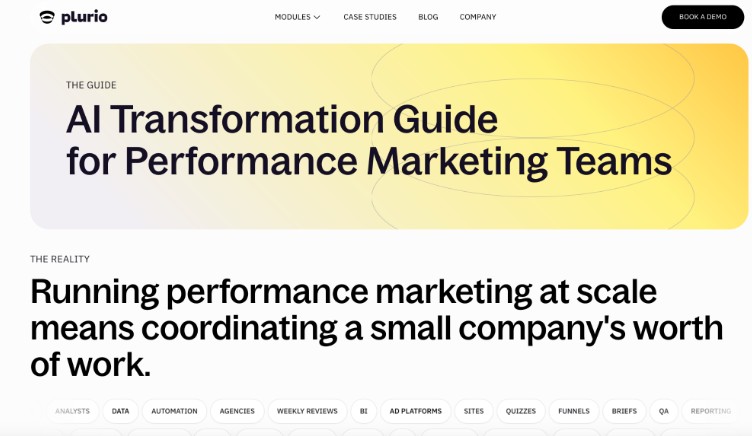
Plurio website
What were the biggest lessons learned from building plurio.ai?
My advice to any startup founder: first, learn how to sell your product on your own. If you’ve never acquired a customer on your own, you’re likely missing a key skill necessary for running a business. Most founders believe this problem is solved by hiring a talented specialist. But, unfortunately, that’s not how it works.
Also, keep an eye out for the right moment. The agent we’re building was technically impossible just a 1,5 years ago. You can’t plan for this, but you can recognize when it’s happening and act quickly when it does.
And if you’re building an AI-focused company, take advantage of this. The team observes what the founder actually does, and if the founder isn’t the most active user of agents in the company, no one else will be either.
Discover Similar Business Ideas Like plurio.ai





More about plurio.ai:
Who is the owner of plurio.ai?
Seva Ustinov is the founder of plurio.ai.
When did Seva Ustinov start plurio.ai?
2023
How much money has Seva Ustinov made from plurio.ai?
Seva Ustinov started the business in 2023, and currently makes an average of $1.8M/year.
More Case Studies Like This





Starter Story × HubSpot
Free tools for every part of your business.
Find customers, win deals, and automate the busywork with HubSpot's free tools.